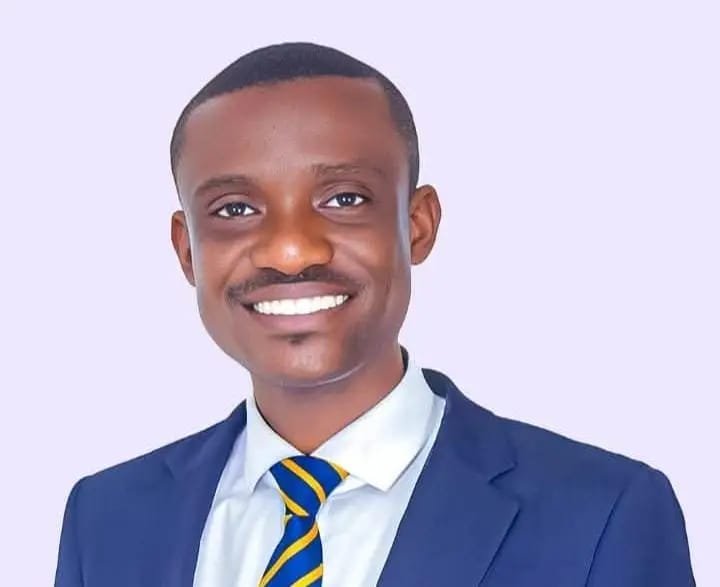
Charles Owusu Juanah
Charles Owusu Juanah, Esq., a legal practitioner and devout Christian, has defefended the National Cathedral of Ghana project, describing it as a sacred national undertaking rooted in law, faith, and visionary leadership not partisanship.
Speaking at the Ghana International Press Centre on Thursday, July 24, 2025, Juanah condemned what he termed as deliberate distortions and politically motivated attacks aimed at derailing the project and eroding public trust. Quoting Psalm 79:10 and Nehemiah 2:18, he rallied Christians and Ghanaians at large to “rise and build,” urging them to defend the project’s integrity and spiritual purpose.
Origin
Mr. Juanah traced the origins of the project to a public vow made in 2016 by then-candidate Nana Addo Dankwa Akufo-Addo, who pledged to construct a National Cathedral if elected president. Upon assuming office, President Akufo-Addo took steps to fulfil that pledge, including the donation of seed capital, commissioning of Sir David Adjaye’s design, and appointment of a legally autonomous Board of Trustees in March 2017 to manage the project’s development.
According to Juanah, the Board was formed under the Companies Act as a company limited by guarantee, not a state-owned enterprise. He emphasized that it operates independently of the Executive and is not subject to the Public Procurement Act. “No government—past, present, or future—has the authority to dissolve the Board outside the scope of judicial processes,” he asserted, referencing the constitutional protection of administrative justice under Article 23.
Allegations
Mr. Juanah offered a firm rebuttal to allegations made by NDC spokesperson Felix Ofosu Kwakye, who recently cited portions of Deloitte’s 2021–2023 audit management letter to claim financial impropriety.
“Mr. Ofosu Kwakye’s claims are politically charged and grossly misleading,” Juanah stated. He clarified that the management letter is a post-audit tool recommending improvementsnot an indictment and that Deloitte’s full audit found no misappropriation of public funds.
Keys issues
Among the key issues Charles Owusu Juanah addressed at the press conference was the payment of GH¢15.7 million to Adjaye & Associates, which he clarified was authorised by the Presidency prior to the formal constitution of the Board of Trustees. He explained that this action was legal, time-bound, and necessary to mobilize the design phase of the project. On the often-cited GH¢4.9 million mismatch, Juanah stated that Deloitte classified the issue as an administrative reconciliation gap, not evidence of fraud or financial impropriety.
Touching on criticisms regarding fundraising efforts in the United States, he indicated that over $400,000 had been raised through a legally registered U.S. nonprofit, adding that the $110,630.56 expended formed part of a wider strategic outreach campaign, not a single event.
Concerns
Juanah also addressed concerns about public contributions made through the ADB MoMo platform, revealing that although the Agricultural Development Bank received over GH¢50 million in donations, none of those funds had been transferred to the Board. He emphasized that the Board could not be held accountable for monies it neither requested nor received.
Regarding the controversial GH¢2.6 million advance from the JNS Talent Centre, Juanah clarified that it was a short-term, interest-free facility from a board member which was repaid within 12 days. He noted that the Commission on Human Rights and Administrative Justice (CHRAJ) reviewed the transaction and found no breach of any law.
He further dismissed claims of duplicate travel funding, insisting that there was no double payment and that official documentation clearly established the trip in question was funded solely by the National Cathedral Secretariat following Board approval.
Outlining the progress made on the project, Juanah reported that the architectural and museum designs had been fully completed, contractors and consultants had been appointed, and land preparation and foundational construction had already been executed, representing eight percent of the total project.
He cited the Deloitte audit which accounted for GHS 225,962,500 received from government, disbursed to Adjaye Associates, RIBADE (main contractor), and the Nehemiah Group, all under valid contracts and verified invoices. He also affirmed that the Public Procurement Authority was involved in key phases and that the Attorney-General had provided legal opinions on the procurement framework.
“The facts are clear: this is not a scandal, it is a project under scrutiny,” he said.
Call
He called on President John Dramani not to politicize the project. “Respect the Church and its sacred mission,” he appealed. He expressed hope that the President would join efforts to complete what he called “a national altar to the Most High.”
He also called on Christians in Ghana and globally to stand in unity and defend the Cathedral from partisan sabotage. “Let us not remain silent while our sacred institutions are denigrated.”
He reaffirmed the National Cathedral’s legal and spiritual foundations, denouncing efforts to portray it as a failed or corrupt initiative. He emphasized that where procedural lapses were identified, they were administrative not criminal and are being addressed transparently.
“This is not a monument to a government. It is a national altar, conceived in faith and executed in law,” he stated.
He called on all Ghanaians, regardless of political affiliation, to support the completion of the Cathedral, warning that distortion and misinformation threaten not just the project but the collective spiritual fabric of the nation.
“The National Cathedral belongs to God. It belongs to Ghana. And its legacy will endure.”
About The Author