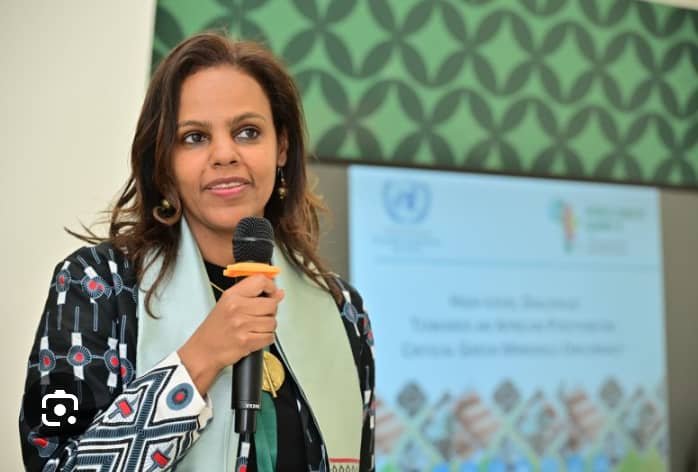
Minister of Fisheries and Aquaculture Development, Hon. Emelia Arthur
The Ministry of Fisheries and Aquaculture Development has disclosed that more than 7,000 stakeholders have been engaged across 21 coastal communities as part of ongoing consultations leading to the establishment of Ghana’s first Marine Protected Area (MPA).
Speaking at a press briefing in Accra on Monday, October 20, 2025, the Minister of Fisheries and Aquaculture Development, Hon. Emelia Arthur, said the extensive consultations represented government’s inclusive approach to marine conservation and the protection of livelihoods dependent on fisheries.
“Working together with the Fisheries Commission and partners, the Ministry has conducted extensive consultations across fishing communities and traditional authorities in 21 participating communities, engaging over 7,000 stakeholders, predominately fisherfolk and community leaders,” the Minister stated.
She noted that the participatory process was guided by a multi-stakeholder MPA Technical Advisory Committee to ensure it “reflects broad consensus and community support and meets the relevant international standards.”
Fisherfolk backing
According to the Minister, fisherfolk and traditional leaders along Ghana’s coastline have largely welcomed the proposed Marine Protected Area, recognizing its potential to restore declining fish stocks and strengthen livelihoods.
“Cabinet gave approval for the creation of Ghana’s first Marine Protected Area within the Greater Cape Three Points area of the Western Region,” Hon. Arthur announced, describing the move as “a significant national milestone in Ghana’s ongoing commitment to sustainable marine resource management, biodiversity protection, and support for the livelihoods of coastal communities reliant on fisheries for income and food security.”
She explained that the Greater Cape Three Points area, covering about 700 square kilometers and stretching from Ampatano to Domunli, “has been scientifically identified as the most suitable location for establishing an MPA”. She added that the site serves as “a critical breeding and nursery ground for sardinellas and other species, as well as an important migratory route for whales and dolphins.”
Ministry’s engagement on coastal communities
Hon. Arthur emphasized that government’s approach to implementing the MPA will be community-driven and grounded in stakeholder participation.
She revealed that the Ministry “will adopt a mixed-use approach for the proposed MPA, rather than implementing a total ban on fishing.” She noted that “this strategy will safeguard livelihoods while promoting responsible and sustainable fishing practices within the designated zones.”
The Minister added that the planned interventions would include mapping and gazetting the MPA designation, inter-ministerial engagements, public education and sensitization, and collaboration with communities, NGOs and faith-based organisations “to integrate local knowledge into the development and implementation of the management plan.”
Inclusive approach
Hon. Arthur stressed that the creation of the Marine Protected Area was not aimed at restricting livelihoods but at ensuring long-term sustainability.
“It is important to clarify that the establishment of the protected area in the Greater Cape Three Points region does not intend to prohibit fishing activities entirely. Rather, its objective is to promote sustainable fishing practices that do not adversely impact the livelihoods of local fishing communities,” she indicated.
She further indicated that the MPA aligned with Ghana’s Blue Economy Strategy, supporting “both blue wealth, encompassing fisheries, aquaculture and tourism, and blue health, which focuses on ecosystem restoration and biodiversity.”
Hon. Arthur furtherbcalled for collective responsibility in implementing the new policy. “The approval by Cabinet of Ghana’s first Marine Protected Area marks a major step toward building a sustainable blue economy which aims to protect marine life and support fishing communities in diverse ways. I therefore call on all stakeholders to collaborate with Government to ensure the successful implementation of this transformative initiative,” she further urged.
About The Author