By Victoria Hamah, PhD
After 60 years, the most shameful blot on the page of national dignity has finally been erased. The Kotoka International Airport has been reverted to its rightful name, Accra International Airport.
This decision by President Mahama represents more than just an administrative rebranding. It signals an effort to interrogate the historical foundations upon which the postcolonial Ghanaian state was constructed.
The airport was named after Lieutenant General Emmanuel Kwasi Kotoka, a central figure in the 1966 coup, which overthrew Kwame Nkrumah. That coup marked a decisive interruption of Ghana’s early post-independence developmental trajectory and inaugurated a period of political instability, throwing Ghana, then the lodestar of Africa, into the decadence of neocolonial subjugation.
Declassified record
Recently declassified records from the Central Intelligence Agency have confirmed that the United States, Britain and France were actively involved in the planning of the coup. While debates persist regarding the precise degree of foreign involvement, the broader historical consensus recognises that the overthrow of Nkrumah occurred within a broader context of Western imperialist efforts to derail the independent developmental model in particular and the pan-African vision in general.
Within this frame, the renaming of the airport functions as an act of narrative correction. It does not merely revisit the legacy of one military officer who was nothing more than a soldier of fortune; it symbolically re-centres Ghana’s identity around civilian constitutional sovereignty rather than military intervention.
In doing so, it aligns with the broader philosophical thrust of President Mahama: that political and economic independence must be reclaimed not only through fiscal and industrial policy, but through the stories nations tell about their own past.
Symbolic gesture
This symbolic gesture addresses an earlier rupture in Ghana’s sovereign development. Together, they articulate a consistent thesis: that independence is neither a completed event nor a ceremonial inheritance, but an ongoing political project requiring institutional, economic, and historical recalibration.
The symbolic timing is equally significant. Sixty years after the infamous 24th February 1966 coup d’état, the renaming signals more than historical reconsideration; it suggests an ideological repositioning.
It indicates an aspiration by the National Democratic Congress (NDC) government toward a consciously pro-Nkrumahist orientation, one grounded in non-alignment, strategic autonomy, and policy independence amid an increasingly turbulent global order.
For John Dramani Mahama’s administration, this does not imply a retreat into isolationism nor a rejection of global engagement. Rather, it reflects a recalibration of Ghana’s external posture: cooperation without subordination, partnership without policy capture.
In a period marked by intensifying geopolitical rivalry and assertive economic diplomacy from powerful states in the Global North, particularly Western nations. The gesture evokes the earlier doctrine of Kwame Nkrumah, who situated Ghana within the Non-Aligned Movement as a sovereign actor rather than a peripheral client.
Read in this light, the act is not revisionist symbolism for its own sake. It articulates a continuity between the Accra Reset and Ghana’s unfinished post-independence project. The 1966 coup interrupted an ambitious experiment in autonomous development and continental leadership.
To revisit that rupture six decades later is to suggest that the questions posed in the 1960s -abhorrent alignment, dependency, and the boundaries of sovereignty – should define the character of political debate.
Economic sovereignty as a foreign policy
President John Dramani Mahama’s unprecedented post-Rawlings era electoral victory carries significance beyond partisan transition. It represents, symbolically, a renaissance of Nkrumahism within Ghana’s contemporary democratic framework.
For the first time since the revolutionary and post-revolutionary dominance of Jerry Rawlings, a renewed mandate has been secured on a platform explicitly invoking structural transformation, strategic autonomy, and continental alignment rather than mere macroeconomic stabilisation.
This moment also clarifies an older historical debate. Prior to the 24 February 1966 coup that overthrew Kwame Nkrumah, there were persistent allegations, advanced by Nkrumah himself, that Western powers, uneasy with Ghana’s non-aligned posture and pan-African activism, exerted economic pressure by manipulating global cocoa markets.
Historical interpretations
As cocoa was Ghana’s principal export and foreign exchange earner, its price volatility had profound fiscal implications. Some historical interpretations further suggest tacit alignment by neighbouring Côte d’Ivoire, which is also a major cocoa producer within broader Western-aligned commodity structures, thereby compounding Ghana’s vulnerability and creating the mood for violent regime change.
Whether interpreted as deliberate sabotage or structural dependency within a commodity-based global economy, the episode reinforced a central Nkrumahist lesson: political sovereignty without economic autonomy is fragile. Mahama’s present mandate appears framed as an effort to transcend that vulnerability without repudiating constitutional democracy or global engagement.
A key example is the decision to move away from syndicated external financing arrangements in the cocoa sector and to prioritise domestic value addition by processing up to half of Ghana’s cocoa output locally. This signals a deliberate shift from dependence on raw commodities toward industrial upgrading.
If implemented effectively, this approach aligns closely with classical Nkrumahist economic thought: retaining greater value within the domestic economy, reducing exposure to external price shocks, and building industrial capacity anchored in existing comparative advantage. It is not autarky but strategic repositioning within global markets.
Renaissance of Nkrumahism
Describing this moment as a renaissance of Nkrumahism, therefore, does not imply a return to one-party statism or Cold War binaries. Rather, it signals the re-emergence of core principles of economic self-determination, continental integration, and calibrated non-alignment within a competitive multiparty order.
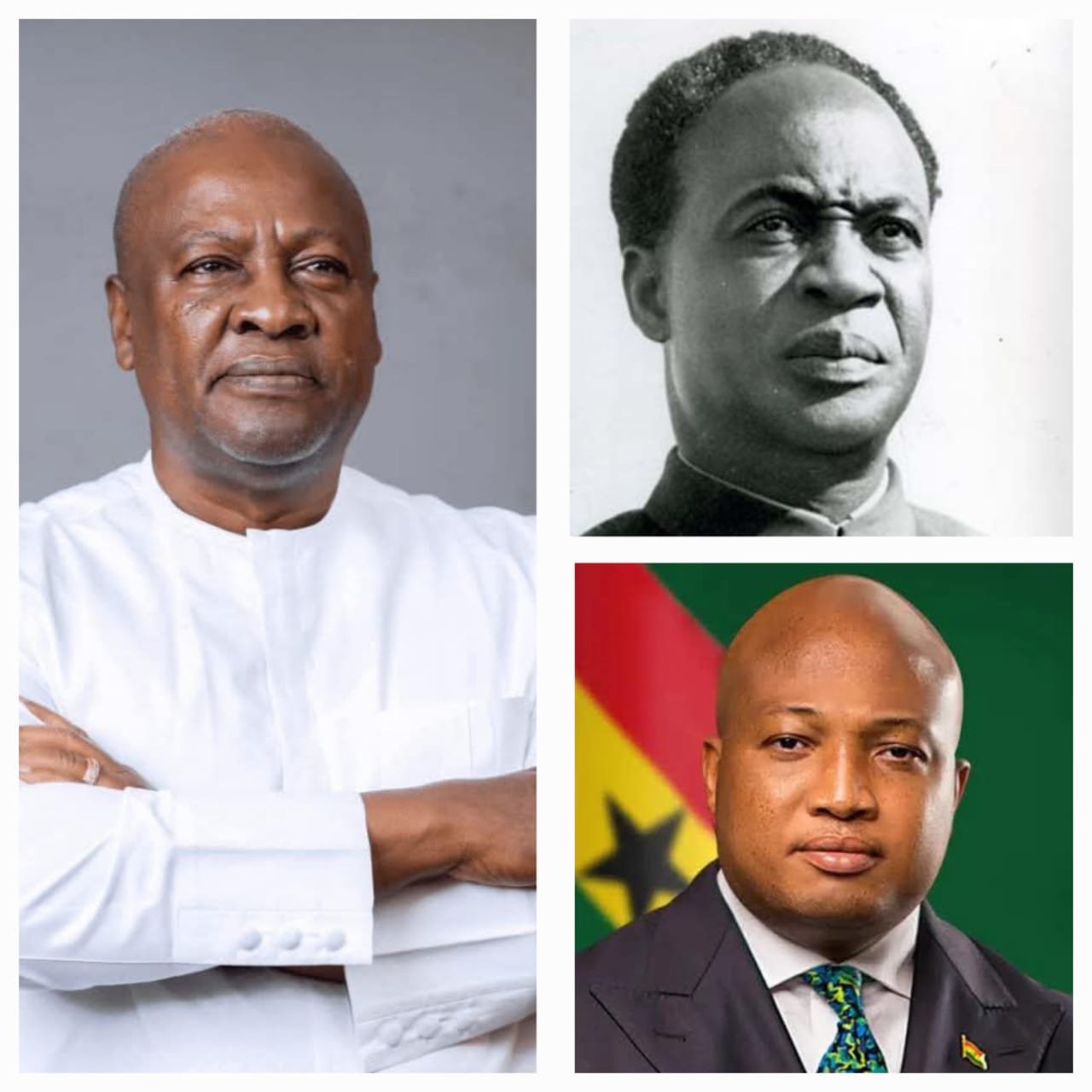
Taken together, the symbolic reconsideration of colonial-era commemorations, the Nkrumahist articulation of foreign policy by Samuel Okudzeto Ablakwa, reforms within the cocoa financing architecture, and Mahama’s renewed electoral mandate, the moment can be read as deliberate ideological consolidation.
It suggests that the questions suspended in 1966 have re-entered Ghana’s political centre, not as nostalgia, but as a strategy: a constitutionalised revival of the unfinished project of autonomous development.
Thus, the Reset Agenda operates on three registers simultaneously: economic restructuring, institutional reform, and historical re-anchoring. Together, they imply that sovereignty is not merely territorial integrity nor formal democratic procedure, but the sustained capacity to determine national priorities without external veto.
If the coup marked the suspension of that ambition, the present moment is framed as its cautious revival.
The writer, Victoria Lakshmi Hamah, is a former Deputy Minister of Communications and holds a Doctor of Philosophy (PhD) in Public Administration and Policy Management from the University of Ghana (UG) Business School, Legon.
About The Author