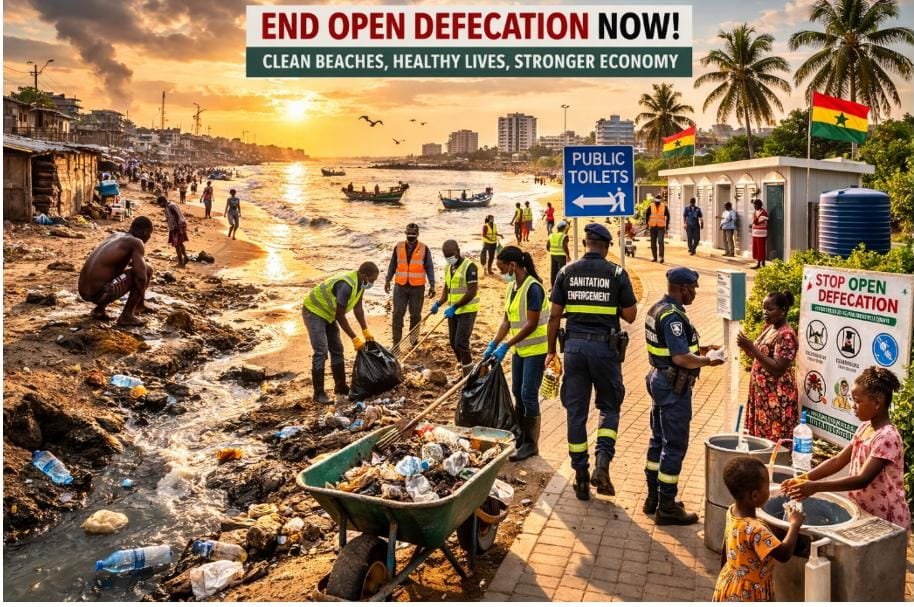
~Nurture Nature Foundation (NNF) advocates
Each time volunteers of Nurture Nature Foundation step onto the beaches of Chorkor, James Town, Korle Gonno, and other coastal communities in Accra, they arrive with gloves, waste bags, and determination. Within hours, plastics are cleared, debris is removed, and stretches of shoreline begin to resemble the tourism assets Ghana promotes to the world.
Yet within days, sometimes hours, human waste reappears. Open defecation resumes. The progress fades. This recurring pattern is not accidental. It reflects a deeper structural challenge rooted in poverty, infrastructure deficits, weak enforcement, and fragmented institutional coordination. The issue demands more than periodic clean-up exercises. It requires systemic reform.
THE SCALE OF THE SANITATION GAP
The sanitation deficit in Ghana is measurable and documented. According to the Ghana Statistical Service 2021 Population and Housing Census, about 7 percent of households nationwide still practice open defecation. Additionally, 17.7 percent of households rely primarily on public toilets.
In Greater Accra, dense coastal settlements such as Chorkor and James Town face unique pressures. Overcrowded compound housing structures often accommodate multiple families sharing limited sanitation facilities. Where toilets exist, they are overstretched. Where they do not, alternatives are limited.
The World Health Organization and UNICEF Joint Monitoring Programme for Water Supply, Sanitation and Hygiene reports that millions of Ghanaians lack access to safely managed sanitation services. In low-income coastal communities, financial barriers make toilet construction unrealistic for many households.
The result is predictable. When families cannot afford pay-per-use public toilets or lack access to private facilities, the beach becomes the fallback option. Poverty drives behavior that compromises public health and environmental integrity.
COST TO PUBLIC HEALTH
Open defecation along the coastline is not confined to the sand. Tides and rainfall wash human waste into the sea, lagoons, and drainage systems. Pathogens spread.
The World Health Organization links inadequate sanitation to diarrheal diseases, cholera, typhoid, and parasitic infections. Ghana has experienced recurrent cholera outbreaks, often associated with poor sanitation and contaminated water.
Children face heightened exposure risks. They play on contaminated beaches and swim in polluted waters. Illness leads to school absenteeism, increased healthcare costs, and long-term developmental consequences.
For fishing communities, the risks multiply. Fisherfolk launch boats from polluted shores. Contaminated coastal waters threaten fish stocks and food safety. What begins as a sanitation problem evolves into a public health and economic crisis.
ENVIRONMENTAL DEGRADATION AND THE BLUE ECONOMY
Beyond immediate health concerns, open defecation damages Ghana’s marine ecosystems. Increased bacterial loads reduce water quality and threaten biodiversity. Coastal ecosystems are sensitive systems. Once degraded, recovery is costly and slow.
Ghana’s artisanal fishing sector supports thousands of livelihoods. Environmental degradation affects catch quality and income stability. The blue economy cannot thrive in polluted waters.
Tourism presents another dimension. Ghana’s coastline is central to its tourism strategy. Clean beaches attract domestic and international visitors. Revenue flows into hospitality, transport, and local enterprises.
The contrast is visible. Beaches near established hotels and restaurants tend to remain cleaner because businesses invest in sanitation infrastructure. Where such facilities are absent, sanitation challenges intensify. Infrastructure shapes outcomes.
LOCAL GOVERNMENT RESPONSIBILITY AND ENFORCEMENT
Sanitation falls under the mandate of District and Metropolitan Assemblies within Ghana’s decentralized governance system. These bodies have the authority to enact and enforce sanitation bylaws.
However, beach monitoring remains inconsistent. Nurture Nature Foundation calls for the establishment of dedicated beach sanitation task forces within coastal District Assemblies. Monitoring must shift from occasional inspections to continuous presence.
Enforcement must be structured and transparent. Sanitation courts already exist. Offenders should face due process. Visible accountability reinforces behavior change.
Yet enforcement without infrastructure is incomplete. Residents cannot comply with sanitation laws if they lack access to affordable facilities.
POVERTY AND THE INFRASTRUCTURE DEFICIT
The Ghana Statistical Service data underscores a central reality. A significant proportion of households rely on shared or public toilets. In coastal low-income communities, daily usage fees accumulate into financial burdens.
For families managing limited incomes, sanitation becomes a cost calculation. The beach becomes the cheapest option.
Addressing open defecation therefore requires addressing poverty-linked infrastructure gaps.
NNF advocates for structured investment in private toilets for underprivileged households. Partnerships between District Assemblies, NGOs, donor agencies, and corporate actors can subsidize toilet construction in vulnerable communities.
BIO-DIGESTER SOLUTIONS AND CIRCULAR ECONOMY OPPORTUNITIES
Bio-digester toilet systems provide a viable solution for space-constrained coastal settlements. These systems treat waste on-site, reduce odor, and require limited land area.
Importantly, bio-digesters convert waste into treated effluent that can be repurposed as organic manure. This creates environmental and agricultural value. Waste management becomes part of a circular economy model.
NNF has gathered practical community-level data indicating willingness among households to maintain facilities if construction costs are supported. Pilot partnerships can demonstrate scalability and measurable impact.
BEHAVIOR CHANGE AND COMMUNITY SENSITIZATION
Infrastructure alone does not guarantee compliance. Sustained behavior change requires consistent education and community engagement.
Evidence from sanitation campaigns across Africa shows that community-led approaches significantly reduce open defecation rates when local leadership is involved. Schools, religious institutions, fisherfolk associations, and women’s groups are critical platforms for sensitization.
Residents must understand the health risks, environmental consequences, and legal implications associated with open defecation. When awareness is combined with access to facilities and enforcement, transformation becomes achievable.
ALIGNING SANITATION WITH THE 24-HOUR ECONOMY
Ghana’s 24-hour economy policy seeks to expand productivity, stimulate job creation, and extend economic activity beyond traditional hours. Coastal sanitation enforcement aligns directly with these objectives.
NNF proposes a Corporate Memorandum between the Environmental Protection Agency, relevant ministries, and Civil Society Organizations to establish a 24-Hour Beach Monitoring Team.
Operating in structured shifts, this team would maintain continuous surveillance along designated coastal zones. Their mandate would include preventing open defecation, apprehending offenders for sanitation court processing, monitoring illegal fishing activities, and reporting child labor incidents in fishing communities.
SECURITY AGENCIES AS STRATEGIC PARTNERS
The Ghana Navy and Marine Police possess the operational capacity to train beach sanitation enforcement teams. Structured training programs can equip recruits with skills in environmental law enforcement, maritime awareness, and community engagement.
This partnership enhances professionalism and credibility. It strengthens institutional coordination between environmental agencies and maritime security bodies.
JOB CREATION AND COASTAL TRANSFORMATION
Ghana’s coastline spans over 500 kilometers. A structured beach monitoring initiative across multiple districts could generate thousands of employment opportunities under the 24-hour economy framework.
These roles would extend beyond sanitation enforcement. Personnel could contribute to environmental protection, tourism safety, and fisheries monitoring. Employment reduces poverty. Reduced poverty lowers sanitation vulnerability.
Clean beaches attract tourists. Tourism generates revenue. Revenue supports community development. The cycle becomes positive rather than destructive.
PARTNERSHIPS AND DONOR ENGAGEMENT
Global research consistently shows that sanitation investment produces high economic returns through reduced healthcare costs and improved productivity. Development partners focused on water, sanitation, and hygiene recognize this multiplier effect.
NNF seeks structured partnerships with NGOs, donor agencies, and private sector actors to finance bio-digester installations, support enforcement employment, and expand community sensitization campaigns.
Hospitality businesses, fisheries enterprises, and tourism operators benefit directly from improved coastal sanitation. Their participation strengthens sustainability.
A NATIONAL MOMENT OF DECISION
Open defecation along Ghana’s beaches is not simply a sanitation concern. It reflects governance effectiveness, social equity, environmental stewardship, and economic ambition.
The solutions are clear. Strengthened District Assembly enforcement. Investment in private toilets for vulnerable households. Deployment of bio-digester technology. Continuous community sensitization. A trained 24-hour beach monitoring team. Strategic collaboration with the Ghana Navy and Marine Police.
The question now is whether coordinated action will follow.
Is Ghana ready to end open defecation?
Is Ghana ready to back Nurture Nature Foundation to end open defecation by leveraging the 24-hour economy policy?
About The Author