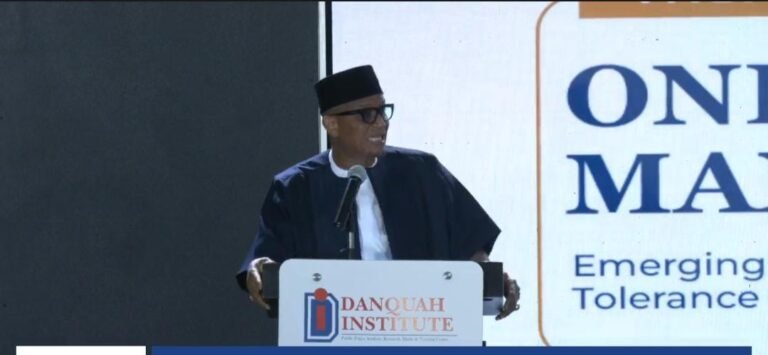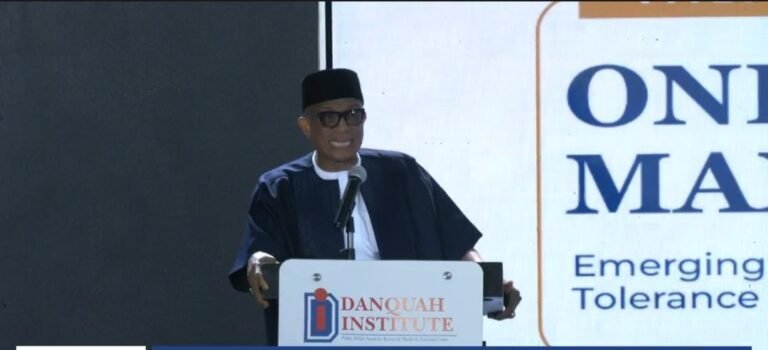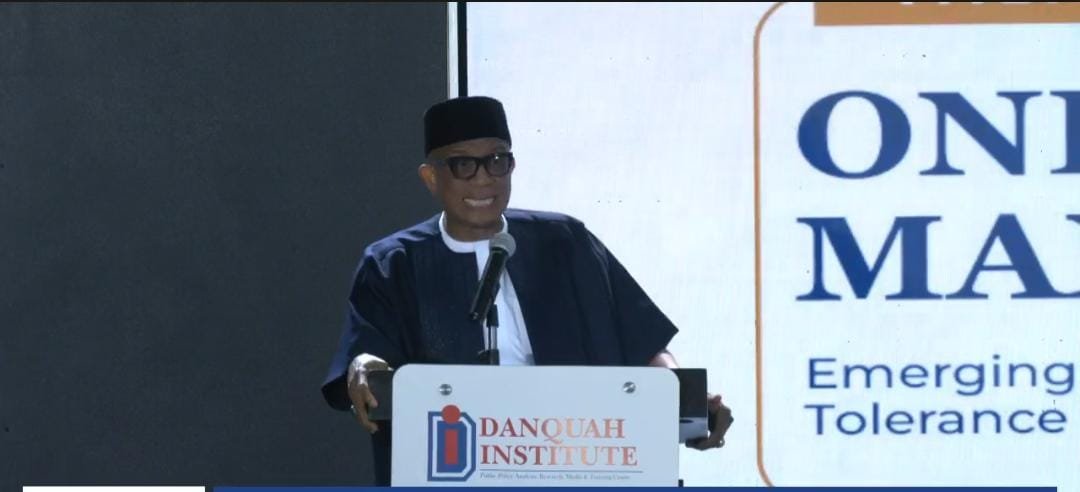
Islamic scholar, academic, politician and former Minister of State, Shaykh Dr. Mustapha Abdul-Hamid
By Bright Philip Donkor
Isamic scholar, academic, politician, and former Minister of State, Shaykh Dr. Mustapha Abdul-Hamid, has warned political actors and religious leaders against exploiting religious differences for partisan advantage, saying Ghana’s long-standing tradition of Christian-Muslim tolerance could be undermined if faith is turned into a tool for political mobilisation.
According to Mustapha Abdul-Hamid, recent developments in Ghana have exposed religious and social cleavages that are increasingly being manipulated for political purposes, particularly as the country approaches the 2028 general election.
Speaking during the 2026 Liberty Lecture Series of the Danquah Institute at Alisa Hotel yesterday, under the theme “One Nation, Many Faiths: Emerging Threats to Religious Tolerance in Ghana,”Mustapha Abdul-Hamid said there was a deliberate attempt to create suspicion and hostility between Christians and Muslims.
“Recent developments threaten that tradition. There is a deliberate attempt to set Christians and Muslims against one another,” Mustapha Abdul-Hamid said.
Religious controversies
Mustapha Abdul-Hamid said a number of recent national controversies had contributed to the growing religious tension, including the legal action by Shafic Osman concerning Muslim worship rights at Wesley Girls High School, proposals by the Ministry of Education to introduce Arabic as an optional subject at the basic school level, and consultations by the Bank of Ghana on interest-free banking.
According to Mustapha Abdul-Hamid, some sections of the Christian community had interpreted those developments as part of an attempt to introduce Sharia law into Ghana, a perception he described as misplaced and dangerous to the country’s religious harmony.
Mustapha Abdul-Hamid said the situation had been further aggravated by viral videos and public statements from religious figures, including a video in which a Muslim cleric called for Muslims to behead anyone who insulted Prophet Muhammad.
He said the statement came in the wake of remarks by a pastor who had described Prophet Muhammad as “a false prophet and a porn star,” turning what should have remained a theological disagreement into a wider public controversy.
“What should have been an academic banter between Muslims and Christians has assumed a political dimension,” Mustapha Abdul-Hamid said.
Political exploitation
He warned that political actors and religious extremists were taking advantage of such disagreements to generate fear and suspicion among voters.
“Political actors and religious bigots have taken advantage to whip up anti-Muslim sentiments in order to instill in voters the ‘dangers’ of a Muslim presidency,” he said.
Mustapha Abdul-Hamid also disclosed that on Sunday, August 9, 2026, a prominent charismatic pastor allegedly declared: “I shall curse any member of my church who votes for the NPP. We shall not allow them to come and disturb Christianity.”
He said such statements were examples of the manner in which political competition could become intertwined with religious identity, warning that the development could have serious consequences for national cohesion.
Historical tensions
Mustapha Abdul-Hamid said Ghana’s experience showed that religious differences had previously generated tensions, citing clashes in Kumasi, Walewale and Sekondi in the early 1990s which, according to him, contributed to a 1995 meeting in Takoradi between the Christian Council and the Federation of Muslim Councils.
He also referred to the death of Adisadel College student Mustapha Gafaru in 2008 after he fled from a teacher because he had reportedly refused to attend church.
Drawing on his academic work, including his 2011 publication Christian-Muslim Relations in Ghana: A Model for World Dialogue & Peace, Mustapha Abdul-Hamid said religious identity could become dangerous when it was allowed to dominate social and political life.
According to Mustapha Abdul-Hamid, both Christianity and Islam have strong religious identities which, if poorly managed, could create intolerance and violence.
Political mobilisation
Citing the work of economist and philosopher Amartya Sen on identity and violence, Mustapha Abdul-Hamid said religion could give people meaning, moral purpose and hope, but should never be converted into an instrument for political mobilisation.
“Religion helps people find meaning, moral purpose and hope in life; it must never become a political weapon,” he said.
Mustapha Abdul-Hamid said Ghana’s religious peace had largely been sustained by a culture of accommodation and mutual respect between Christians and Muslims.
He cited the Presbyterian Hospital in Bawku, the Baptist Medical Center in Nalerigu and the late Dr. David Abdulai Choggu’s Shekhinah Clinic in Tamale as examples of Christian institutions and individuals serving Muslim communities without allowing religious differences to become barriers.
Interfaith tolerance
He also highlighted the actions of National Chief Imam Sheikh Osman Nuhu Sharubutu, including his decision to allow the International Central Gospel Church to paint the Central Mosque at Abossey Okai and his attendance at Christ the King Church on Easter Sunday in 2019 at the age of 100.
For Mustapha Abdul-Hamid, such examples demonstrated that religious diversity could coexist with national unity when citizens respected one another’s beliefs.
“Ghana is one nation of many faiths, but also one nation largely united in belief in one supreme being,” he said.
He invoked the words attributed to the Sufi poet Rumi that “the light is one, though the lamps are many,” arguing that different religious traditions should not prevent Ghanaians from recognising their shared humanity and national identity.
Religious stereotyping
Mustapha Abdul-Hamid also warned against attempts to portray the possible election of a Muslim president as a threat to Ghana’s religious character.
He said Ghana’s political history did not support the argument that Muslims were pursuing a collective agenda to Islamise the country, pointing to the voting patterns of Muslim-majority constituencies in the 2024 general election.
According to Mustapha Abdul-Hamid, several Muslim-dominated constituencies voted overwhelmingly for President John Dramani Mahama, a Christian, rather than Dr. Mahamudu Bawumia, a Muslim.
He said the voting pattern demonstrated that religious identity did not automatically determine the political choices of Ghanaian voters.
Religious polarisation
Mustapha Abdul-Hamid urged Ghanaians to resist attempts to turn religious differences into political fault lines ahead of the 2028 elections.
“We must resist those who exploit religious differences for partisan gain and divide a people whose faith traditions have long coexisted in mutual respect,” he said.
He said the preservation of Ghana’s religious peace required political leaders, religious authorities and citizens to reject inflammatory rhetoric and protect the country’s tradition of peaceful coexistence.
Mustapha Abdul-Hamid said Ghana’s religious diversity should ultimately be treated as a source of strength rather than a basis for political division, stressing that the country’s unity depended on the ability of its citizens to accommodate differences while maintaining a shared commitment to peace.
About The Author