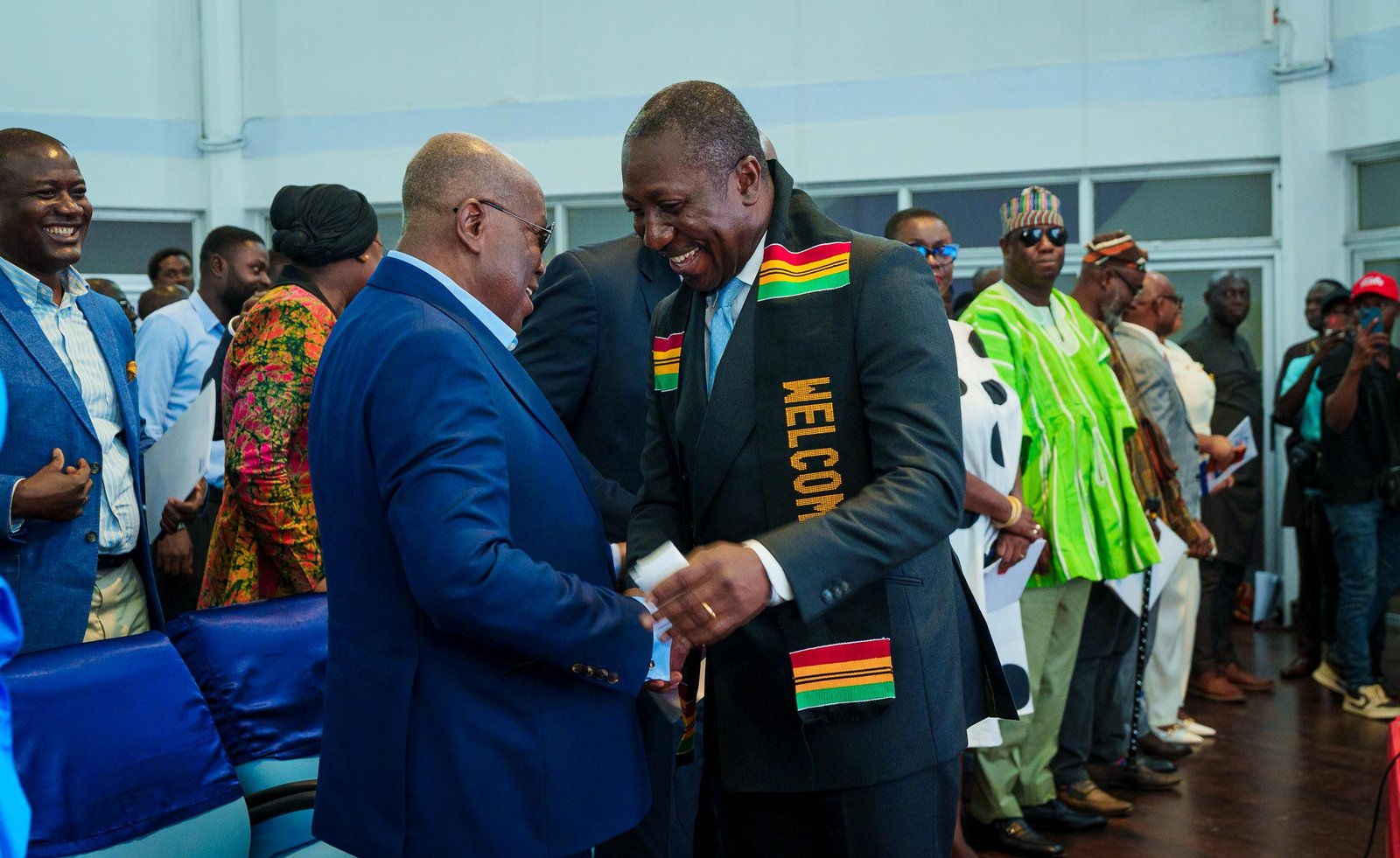
Osahen Afenyo-Markin shares a hearty handshake with Nana Akufo-Addo at the IERPP Lecture Series
By Bright Philip Donkor
The Minority Leader, Osahen Kwamena Afenyo-Markin, has delivered a comprehensive ideological defence of the Danquah-Dombo-Busia political tradition. He argued that its centre-right philosophy had been central to Ghana’s socio-economic transformation under the administrations of President John Agyekum Kufuor and President Nana Addo Dankwa Akufo-Addo.
Speaking during the Institute of Economic Research and Public Policy’s (IERPP) maiden lecture series, titled “The Danquah-Dombo-Busia Centre-Right Ideology and Its Impact on Ghana’s Socio-Economic Development: A Focus on the Kufuor and Akufo-Addo Governments,” the Minority Leader said the tradition had consistently prioritised liberty, constitutional governance and the empowerment of the individual citizen as the foundation for national development.
“Our party’s effort will be to liberate the energies of the people for the growth of a property-owning democracy in this land, with right to life, freedom and justice, as principles to which Government and laws of the land should be dedicated in order specifically to enrich life, property and liberty of each and every citizen,” he added.
Osahen Afenyo-Markin stated unequivocally that this declaration formed the philosophical backbone of the New Patriotic Party’s governance record in the Fourth Republic.
“Elitism” charge
The Minority Leader said he chose to “face the charge directly” that the Danquah-Dombo-Busia tradition is elitist, noting: “That charge has been repeated in newspapers, shouted at rallies, and whispered in classrooms… that ordinary Ghanaians… have no real place in its story.”
He argued: “A tradition is not judged by where it comes from. It is judged by where it is going… It is judged by the direction of its policies.”
According to him, the true measure of the tradition lies in policy outcomes under Kufuor and Akufo-Addo, which he said “consistently fought not to protect an elite, but to build a path that leads every Ghanaian into one.”
“3” political traditions
The MP for Effutu further outlined what he described as Ghana’s three major traditions: Nkrumah’s, the Rawlings tradition and the Danquah-Dombo-Busia tradition.
Referencing Kwame Nkrumah, he stated: “Nkrumahism placed the state at the centre of development… State-owned enterprises, centralised economic planning, and the concentration of political authority… were the instruments.”
On the Rawlings era under Jerry John Rawlings, Osahen Afenyo-Markin said, it combined “radical populist rhetoric” with structural adjustment policies.
By contrast, he asserted: “The Danquah-Dombo-Busia tradition placed the free, rights-bearing individual at the heart of the national project.”
He stressed that, unlike other traditions, “the tradition has never seized power by force. It has won it at the ballot box, accepted electoral defeat when it occurred, and remained consistently committed to constitutional governance.”
The Kufuor years
The Minority Leader indicated that the introduction of the National Health Insurance Scheme under Kufuor disproves the elitism narrative.
“It was the NPP government, the party accused of elitism, that removed the financial barrier between a sick Ghanaian and the healthcare they needed,” he recalled.
He described the NHIS as “an investment in the capacity of Ghanaian people to be healthy, productive, and able to build lives for themselves.”
On education, he cited Article 25(1)(a) of the 1992 Constitution, stating: “The Kufuor government took that constitutional mandate seriously and did the practical work of turning it into reality.”
He referenced the Capitation Grant and School Feeding Programme, noting that enrolment rose from “around 85 percent to over 90 percent by 2008,” particularly benefiting girls and rural children.
On oil discovery, Osahen Afenyo-Markin credited the Kufuor administration’s investor-friendly framework that led to the 2007 Jubilee Field discovery. He described it as “an ideological proof of concept… that wealth is created most reliably not by a state that seizes productive assets, but by a state that creates the conditions in which free, well-regulated private enterprise can find and develop them.”
The Akufo-Addo era
Turning to Akufo-Addo’s tenure, the Minority Leader described Free Senior High School as “a historic turning point.” “Between 2017 and 2024, 3,046,172 young Ghanaians gained access to secondary education,” he stated.
He argued that before Free SHS, secondary education was “practically a privilege,” adding: “Free SHS changed that reality.” He further stated: “There can be no reversal of Free SHS and Free TVET without reversing the progress made in social mobility.”
On technical and STEM education, he highlighted the establishment of 34 new TVET institutions, 20 STEM centres and 10 model STEM SHSs, saying: “We are not merely training workers. We are training owners.”
1D1F & PFJ
The Minority Leader also described the One-District-One-Factory initiative as “the clearest expression of the Danquah–Busia–Dombo tradition’s belief in private-sector-led development.”
He cited figures of 321 projects at various stages and approximately 169,870 jobs created, arguing that the policy sought to expand the “property-owning democracy” by “transforming citizens from economic spectators into participants.”
He mentioned that the Planting for Food and Jobs (PFJ) redefined agriculture by shifting from subsistence support to productivity-driven empowerment.
He linked cocoa sector reforms under Kufuor to Danquah’s earlier advocacy as “Akuafo Kanea,” stating: “The producer has rights. The worker has dignity. The citizen is not a means to the state’s ends. The state is a means to the citizen’s flourishing.”
Ghana Card and Digital Identity
He lauded the Ghana Card project, saying it “transformed identity into a platform for opportunity.” He argued that secure legal identity enables citizens to “open bank accounts, access credit, register businesses, acquire property, pay taxes and transact with confidence.”
From a centre-right perspective, he stated: “A secure legal identity is foundational to participation in a property-owning democracy.” In what he described as a “new frontier for an old vision,” Osahen Afenyo-Markin linked digital transformation to Danquah’s philosophy.
“In cyberspace, your father’s income does not determine your ranking… The internet does not ask where you come from. It asks what you can do,” he added.
He emphasised that investments in STEM and digital skills are “property policy,” equipping young Ghanaians to own digital assets in the Fourth Industrial Revolution.
Akufo-Addo/ Kufuor records
Osahen Afenyo-Markin further noted that the records of Kufuor and Akufo-Addo demonstrate that the Danquah-Dombo-Busia tradition is not elitist but empowering.
“These are not the achievements of a tradition indifferent to ordinary people. These are the achievements of a tradition that has consistently tried to make ordinary people extraordinary,” he added.
He urged scholars and young people to engage deeply with the founding texts of the tradition, stressing that its principles of liberty, constitutionalism, and enterprise remain “urgencies of the present.”
About The Author