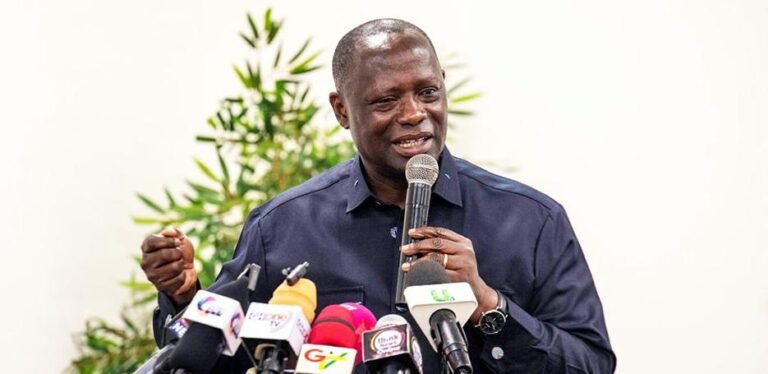
Dr. Kwasi Nyame-Baafi, a director of the Institute of Economic Research and Public Policy (IERPP)
The Institute of Economic Research and Public Policy (IERPP) has called for a sweeping overhaul of Ghana’s public sector recruitment architecture, urging authorities to adopt a merit-based, transparent and fee-free system to restore credibility and fairness in employment processes.
Addressing a press conference at the Ghana International Press Centre on Tuesday 17th March 2026, under the theme “E-Merit Recruitment Saga: From Hope to Heartbreak,” a Director of IERPP, Dr. Kwasi Nyame-Baafi, warned that the country’s labour market is showing signs of deep structural weakness despite marginal improvements in headline indicators.
He explained that while unemployment declined slightly from 14.9 per cent in 2023 to 13.6 per cent in 2024, and further to 13.1 per cent in the fourth quarter, the underlying realities remain troubling. Youth unemployment, he noted, continues to surge, standing at 22.5 per cent for persons aged 15 to 35 and peaking at 32 per cent among those between 15 and 24.
“Seven out of every 10 unemployed persons in Ghana are young people,” Dr. Nyame-Baafi said, adding that the situation is compounded by high rates of young people not in employment, education or training. According to him, NEET rates of 25.8 per cent for ages 15–24 and 22.4 per cent for ages 15–35 reflect a generation increasingly disconnected from productive engagement.
He further pointed to disparities between urban and rural labour markets, noting that unemployment in urban centres stands at 15.9 per cent, significantly higher than the 10.4 per cent recorded in rural areas, a trend he attributed to congestion and weak job absorption capacity in major growth hubs.
Against this backdrop, he referenced the ambitious “Jobs for All” agenda advanced by the National Democratic Congress, which is anchored on policies such as a 24-hour economy, a $10 billion “Big Push,” a $3 billion digital jobs programme, agro-industrial zones and youth enterprise initiatives.
While acknowledging the scale and intent of these policy proposals, Dr. Nyame-Baafi indicated that their implementation has revealed significant gaps, particularly in the area of recruitment into the security services.
He cited the recent security recruitment exercise as a case in point, describing it as a system that, although presented as inclusive and technology-driven, ultimately exposed infrastructure inequalities and systemic inefficiencies. Internet-based testing, he argued, disadvantaged thousands of applicants due to uneven access to reliable connectivity across the country.
Reports from the exercise suggest that only about 20 per cent of applicants were able to successfully navigate the process, raising questions about fairness and accessibility.
More critically, the IERPP director raised concerns about the financial structure underpinning the recruitment exercise. With over 500,000 applicants each paying GH¢220, the process generated an estimated GH¢110 million in revenue. However, only 5,000 individuals were recruited, representing a conversion rate of just one per cent.
“In effect, nearly half a million applicants contributed about GH¢108.9 million without securing employment. This translates to roughly GH¢22,000 collected for every successful recruit. The question we must ask is whether this is a recruitment exercise or a revenue model,” he stated.
He further situated the issue within the broader fiscal framework, noting that the Ministry of the Interior is projected to increase its Internally Generated Funds from GH¢678.3 million in 2024 to GH¢1.114 billion by 2026. According to him, such high-volume, low-conversion recruitment models risk evolving into mechanisms for revenue mobilisation rather than genuine employment creation.
Dr. Nyame-Baafi also raised governance concerns, questioning the centralisation of recruitment processes at the ministerial level instead of allowing security agencies to lead. He cited inconsistencies in eligibility expansion, limited financial clearance relative to reported vacancies, and the imposition of non-refundable fees despite extremely high rejection rates.
“These inconsistencies point to policy incoherence and weak institutional alignment,” he stated.
The Institute is therefore calling for an independent investigation into the recruitment process, including financial flows, procurement arrangements, technological systems and final selection outcomes.
Beyond the call for accountability, the IERPP proposed a comprehensive reform agenda anchored on meritocracy and inclusivity. Central to this is the adoption of a fee-free recruitment model that eliminates financial barriers and ensures that opportunities are allocated strictly based on competence and qualification.
The Institute also recommended the establishment of a National Youth Employment Taskforce to coordinate a structured, multi-year absorption plan for the approximately 470,000 unsuccessful applicants. This, it said, should include skills mapping, sector matching and phased recruitment into high-demand sectors such as healthcare, education, ICT, agriculture and security.
Additionally, it proposed the expansion of public-private partnerships to create more employment pathways, alongside short-term bridging programmes designed to equip young people with job-ready skills within three to six months.
Dr. Nyame-Baafi stressed that Ghana faces a fundamental policy choice: whether to monetise unemployment or to systematically reduce it through productivity-driven interventions.
“One approach extracts value from desperation, while the other builds value through opportunity and inclusion. Only one of these is sustainable,” he further stated.
About The Author