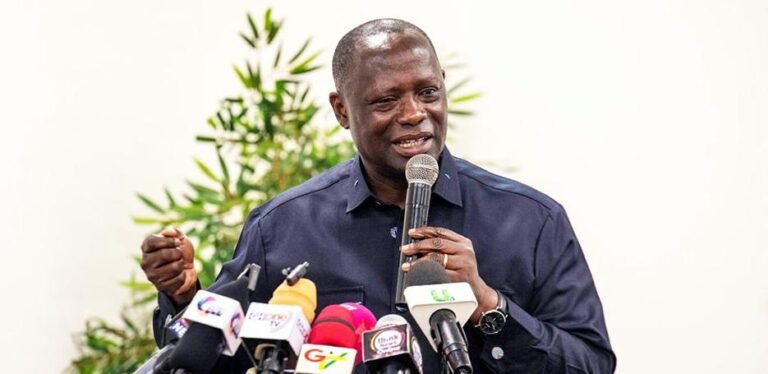
Dr. Kwasi Nyame-Baafi, a director of the Institute of Economic Research and Public Policy (IERPP), engages the press
The Institute of Economic Research and Public Policy (IERPP) has observed that Ghana’s labour market, particularly the recent E-Merit security recruitment exercise, has deepened frustration among the youth instead of delivering the opportunities it promised.
Addressing a press conference at the Ghana International Press Centre (GIPC) on Tuesday, 17th March 2026, under the theme “E-Merit Recruitment Saga: From Hope to Heartbreak,” a Director of IERPP, Dr. Kwasi Nyame-Baafi, said the country’s employment figures reveal a troubling disconnect between headline improvements and the lived realities of young people.
He explained that although overall unemployment declined from 14.9 per cent in 2023 to 13.6 per cent in 2024, further dropping to 13.1 per cent in the final quarter of the year, the situation remains dire for the youth. According to him, unemployment among persons aged 15 to 35 stands at 22.5 per cent, while the figure rises sharply to 32 per cent for those between 15 and 24 years. He added that seven out of every ten unemployed persons in Ghana are young people.
Dr. Nyame-Baafi also pointed to rising levels of young people who are not in employment, education, or training (NEET), describing it as evidence of a generation increasingly disconnected from productive activity. He noted that urban unemployment, estimated at 15.9 per cent, continues to outpace rural unemployment of 10.4 per cent, a situation he attributed to congestion in cities and the limited capacity of growth centres to absorb job seekers.
“This is not a cyclical issue,” he stressed. “It reflects a deeper structural fragility within the economy.”
He recalled that the National Democratic Congress had presented what he described as an ambitious “Jobs for All” agenda, built around a 24-hour economy, a $10 billion “Big Push,” a $3 billion digital jobs programme, agro-industrial zones, and youth enterprise initiatives. The framework, he said, was widely seen as a bold commitment to tackling unemployment through large-scale and inclusive interventions.
However, he indicated that the gap between policy ambition and actual outcomes has become increasingly evident, particularly in the execution of the recent security recruitment exercise. What was introduced as a modern, digital, and inclusive system, he said, ended up exposing deep inequalities in infrastructure and access.
He noted that the reliance on internet-based testing disadvantaged many applicants in areas with poor connectivity, effectively shutting them out of the process. Reports suggesting that only about 20 per cent of applicants were able to successfully complete the process, he added, raise serious questions about fairness and system design.
Beyond access challenges, Dr. Nyame-Baafi drew attention to the financial implications of the exercise. With more than 500,000 applicants each paying GH¢220, the process generated approximately GH¢110 million. Yet, only 5,000 individuals were recruited, representing a success rate of just one per cent.
In practical terms, he said, nearly half a million applicants paid for an opportunity that did not materialise, contributing about GH¢108.9 million without securing employment. He questioned whether the structure of the exercise served its intended purpose or risked creating the impression of a revenue-driven system.
The situation, he added, becomes even more concerning when viewed within the broader fiscal outlook of the Ministry of the Interior, whose Internally Generated Funds are projected to rise significantly in the coming years. He cautioned that recruitment models characterised by high application volumes and extremely low intake could inadvertently shift focus from job creation to revenue mobilisation.
Dr. Nyame-Baafi also raised governance concerns, including the centralisation of recruitment at the ministerial level, the widening of eligibility criteria without corresponding increases in available positions, and the imposition of non-refundable fees despite the overwhelming likelihood of rejection. He further questioned why recruitment was limited to 5,000 positions when reports indicate that vacancies within the security services exceed 30,000.
“These inconsistencies point to a lack of coordination and clarity in policy execution,” he said.
He called for an independent investigation into the recruitment process, including its financial arrangements, technological systems, procurement decisions, and final selection outcomes. According to him, restoring public confidence will depend heavily on transparency and accountability.
Dr. Nyame-Baafi further urged the government to adopt a more structured and humane approach to addressing youth unemployment. He proposed a multi-year plan to absorb affected applicants through targeted interventions across sectors such as healthcare, education, agriculture, ICT, and security.
He also emphasised the need for stronger collaboration between the public and private sectors, as well as short-term training programmes that can equip young people with employable skills within a few months. Above all, he advocated a shift towards a merit-based and fee-free recruitment system, supported by a dedicated National Youth Employment Taskforce.
“The choice before us is simple. We can either continue to extract value from unemployment, or we can invest in building a productive and inclusive economy. Only one of these paths is sustainable,” he further told the press.
About The Author