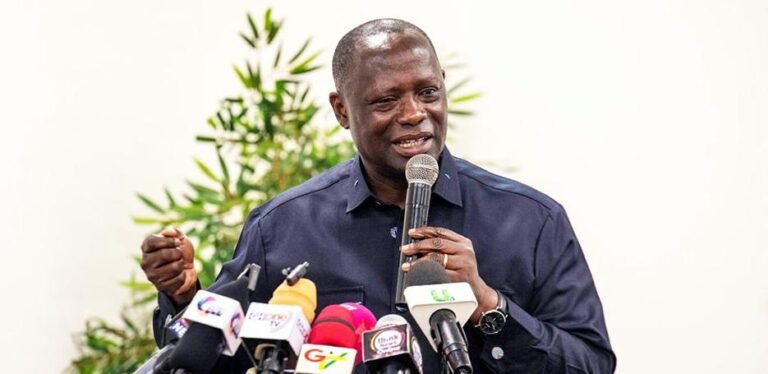
Dr. Kwasi Nyame-Baafi, a director of the Institute of Economic Research and Public Policy (IERPP), addresses the press
The Institute of Economic Research and Public Policy (IERPP) has cautioned against a growing risk of ‘monetising unemployment’ in Ghana, as recent recruitment exercises, particularly within the security services, drift from their core purpose of job creation toward revenue generation.
Addressing a press conference under the theme “E-Merit Recruitment Saga: From Hope to Heartbreak” at the Ghana International Press Centre on Tuesday, 17th March 2026, a director of IERPP, Dr. Kwasi Nyame-Baafi, painted a sobering picture of the country’s labour market—one he said reflects not a temporary downturn, but a deeper structural weakness.
According to him, while headline unemployment figures show a marginal decline—from 14.9 per cent in 2023 to 13.6 per cent in 2024, and further to 13.1 per cent in the final quarter of the year—the apparent improvement masks a more troubling reality. Youth unemployment remains disproportionately high, standing at 22.5 per cent for persons aged 15 to 35, and rising sharply to 32 per cent among those aged 15 to 24. In practical terms, seven out of every ten unemployed Ghanaians are young people.
He noted that the situation is further compounded by persistently high NEET (Not in Employment, Education or Training) rates, with 25.8 per cent recorded among persons aged 15–24 and 22.4 per cent among those aged 15–35. Urban centres, often seen as hubs of opportunity, are instead bearing the brunt of the crisis, with unemployment at 15.9 per cent compared to 10.4 per cent in rural areas.
“This is not cyclical unemployment that will correct itself with time,” Dr. Nyame-Baafi emphasised. “What we are witnessing is structural fragility—an economy that is not creating enough productive opportunities for its growing youth population.”
It is against this backdrop that he examined the government’s broader employment agenda, particularly the much-publicised “Jobs for All” policy framework, which promised large-scale job creation through initiatives such as a 24-hour economy, a multi-billion-dollar infrastructure push, digital employment programmes, and agro-industrial development.
While acknowledging the ambition behind the policy architecture, Dr. Nyame-Baafi argued that recent implementation efforts reveal a widening gap between promise and reality.
He cited the latest security recruitment exercise as a case in point. Originally presented as a transparent, inclusive and technology-driven system, the process, he said, instead exposed deep inequalities in access and execution.
“The reliance on internet-based testing in a country with uneven digital infrastructure effectively excluded thousands of otherwise qualified applicants,” he noted, adding that only about 20 per cent of candidates were able to successfully complete the process.
More critically, he questioned the financial structure underpinning the exercise. With over 500,000 applicants each paying GH¢220, the process generated an estimated GH¢110 million. Yet, only about 5,000 individuals were ultimately recruited.
“In effect, nearly half a million applicants paid for an opportunity that never materialised,” he said. “When you break it down, it means roughly GH¢22,000 was collected for every successful recruit. At that point, one must ask—are we running a recruitment exercise or a revenue model?”
The IERPP further warned that the issue cannot be viewed in isolation from broader fiscal trends. Projections indicate that Internally Generated Funds within the security sector are expected to rise significantly in the coming years, a development that, if not carefully managed, could incentivise high-volume, low-conversion recruitment drives.
Dr. Nyame-Baafi cautioned that scaling such a model to meet higher recruitment targets would produce outcomes that are not only administratively impractical but also socially damaging.
“Imagine needing four million applicants to recruit 40,000 people under the same model. That is not just unrealistic—it is regressive,” he said.
Beyond the financial concerns, the Institute raised several governance questions, including the centralisation of recruitment processes at the ministerial level, the expansion of eligibility criteria without corresponding increases in absorption capacity, and the imposition of non-refundable application fees in a system where rejection rates exceed 99 per cent.
“These inconsistencies point to weak institutional coordination and policy incoherence,” he added.
The IERPP is therefore calling for an independent investigation into the recruitment exercise, covering financial flows, procurement arrangements, technological systems, and final selection outcomes. According to the Institute, restoring public confidence will require full transparency and accountability.
But beyond critique, Dr. Nyame-Baafi stressed the need for a forward-looking response—one that treats the hundreds of thousands of unsuccessful applicants not as mere statistics, but as a pool of untapped human capital.
He proposed a structured, multi-year absorption strategy anchored on skills mapping and sector-specific deployment, particularly in high-demand areas such as healthcare, education, ICT, agriculture, and security services. He also called for stronger public-private collaboration and the introduction of short-term bridging programmes to equip young people with job-ready skills.
Central to these reforms, he insisted, must be a shift toward a merit-based, transparent and non-fee recruitment system, backed by a dedicated National Youth Employment Taskforce with clear performance targets.
“The policy choice before us is straightforward. We can either monetise unemployment or we can reduce it through deliberate, productivity-driven strategies. One feeds on desperation; the other builds national capacity. Only one of these paths is sustainable,” he further emphasised.
About The Author