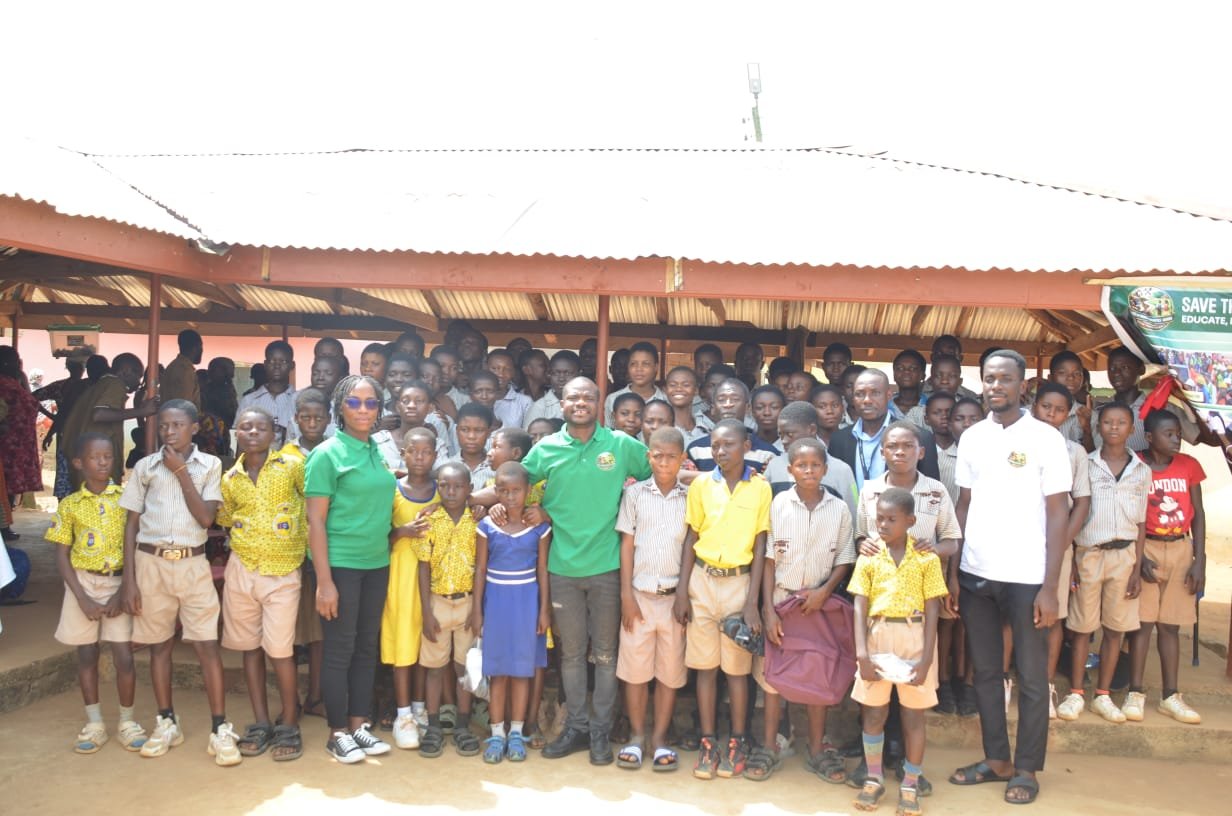
Just 24 hours after losing his father, Andrews Kwame Perprem stood before residents of his childhood village and did what few would have found the strength to do: he launched a movement.
There was no air-conditioned conference hall in Accra, no elaborate ceremony, no protective distance between speaker and story. Instead, he stood on the soil of Agyapomaa, near Kyebi in the Abuakwa South Municipality — the same soil that had once borne witness to his hunger, humiliation, and hardship.
There, he unveiled Save the Mining Communities–Ghana (SMC-Gh), a non-governmental organisation committed to defending mining communities, protecting vulnerable children, promoting safer livelihoods, and advocating sustainable environmental practices in areas devastated by illegal mining.
His voice was steady, but grief lingered beneath every word.
“Leadership is not always convenient. Service is not always comfortable. But when the cause is greater than self, you rise, even when your heart is heavy,” he told the gathering.
A Launch Born Out of Pain
The timing of the launch was both painful and symbolic. His father had passed away just the day before. Many expected a postponement. Instead, Perprem chose action as tribute.
He described the event as an offering to the man who, despite limited means, single-handedly raised ten children and insisted that education would be their only true inheritance.
“My father would have been sad,” he said, “if education was not at the heart of this mission. Education is the only durable bridge out of generational poverty.”
Embedded in that declaration is the philosophy driving SMC-Gh: that poverty in mining communities is not accidental. It is structural, cyclical, and sustained by neglect.
“Childhood Poverty Is More Brutal Than Any Poverty”
Perprem’s address was less a speech and more a confession. Born and raised in Agyapomaa until the age of twelve, he painted a deeply personal portrait of deprivation that left many in the crowd visibly moved.
“Childhood poverty is more brutal than any form of poverty in existence,” he said. “As a child, you are vulnerable. You have no working skills, no energy, no knowledge for the labour market. You are at the mercy of the weather and the benevolence of nature.”
He spoke of attending school on an empty stomach. Of his great-grandmother, Nana Adjoa Fordjour, begging for food to cook for him. Of market days when he collected plantain scraps partially eaten by goats, washed them, and cooked them for survival.
At just eight years old, he walked alone into the forest to search for wild kola nuts to sell so he could buy clothes. His great-grandmother, then over 100 years old, fished to provide protein for their meagre meals.
“Life was a living hell,” he said quietly. “I often wondered whether I would survive the next day.”
Yet amid hunger and humiliation, he remained devoted to his education. He endured mockery and disrespect, but consistently ranked first in his class.
That paradox — academic excellence in the midst of starvation — now fuels his determination.
Empty Classrooms, Full Mining Pits
Ahead of the launch, Perprem visited local classrooms. Many were nearly empty. The reason, he said, was painfully familiar. The children were not absent out of indifference. They were at galamsey sites — illegal mining pits — searching for food, income, and survival.
Three decades after his own childhood struggle, poverty remains entrenched in Agyapomaa and across Ghana’s mining communities. Environmental degradation has polluted rivers. Human rights abuses persist. School attendance remains inconsistent. Children exchange books for shovels.
Through SMC-Gh, Perprem intends to confront these realities directly. The organisation seeks to protect children from exploitation in illegal mining zones, advocate sustainable and responsible mining practices, promote alternative livelihoods for families trapped in dependency on destructive extraction, and restore dignity to communities long treated as expendable.
He insists this is not charity. It is a call for structural change. It challenges the normalisation of environmental destruction. It confronts complacency surrounding child labour. It demands accountability in the governance of Ghana’s natural resources.
Leadership Forged in Hardship
Perprem did not present his childhood as a tale of victimhood, but as preparation. He attributed much of his early struggle to growing up in a broken home and used the occasion to urge parents, particularly fathers, to prioritise their children even when marriages fail.
“Children must not pay the price for adult conflicts,” he stressed.
His own trajectory shifted at age twelve when he moved to Accra to live with his father, who ensured his continued education. That intervention, he said, changed the course of his life and now compels him to intervene in the lives of others.
By proceeding with the launch a day after his father’s passing, Perprem offered a model of leadership rarely seen in contemporary public life — one grounded in sacrifice rather than spectacle.
Residents of Agyapomaa praised his resilience. But what unfolded was more than resilience. It was conviction.
A Movement, Not a Moment
Save the Mining Communities–Ghana emerges at a pivotal moment for the nation. As debates intensify over illegal mining, environmental degradation, youth unemployment, and educational inequality, SMC-Gh positions itself at the intersection of each crisis.
It raises difficult questions. Why do mineral-rich communities remain among the poorest? Why must children risk death in mining pits to survive? Why has generational poverty become normalised in resource-abundant regions? And who benefits from the silence?
Perprem’s message is unambiguous: development cannot be measured by extraction alone. It must be measured by the transformation of lives, systems, and futures.
As dusk settled over Agyapomaa, the symbolism was striking. A grieving son stood on the soil of his childhood suffering and declared that no child should endure what he endured.
Grief did not silence him. It sharpened his resolve.
In honouring his father, Andrews Kwame Perprem may have ignited something far larger than a local initiative. He may have initiated a national reckoning — one that insists leadership is service, service demands sacrifice, and the fight against generational poverty cannot wait for convenient timing.
Because when the cause is greater than self, you rise — even when your heart is heavy.
About The Author