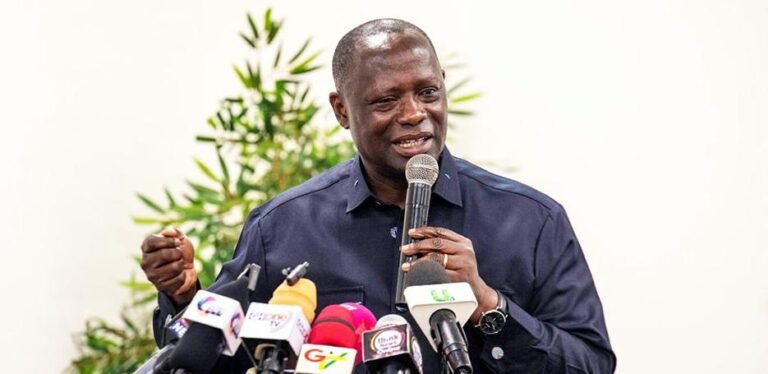
By Gabby Asare Otchere-Darko
The Africa Prosperity Network (APN) warmly welcomes the announcement that President John Dramani Mahama is in Arusha, Tanzania, to address the opening of the 2026 judicial year of the African Court on Human and Peoples’ Rights, marking the Court’s 20th anniversary.
It will be the first time a sitting President of the Republic of Ghana has been invited to address the Court. The theme, “20 Years of Service in Protecting Human and Peoples’ Rights in Africa”, is both reflective and forward-looking. But how forward-looking will we allow it to be?
The timing is significant. President Mahama will assume the Chairmanship of the African Union next February. And, 2027 will be just one year before the 2028 deadline our leaders set for themselves under the 1991 Abuja Treaty to establish the African Economic Community, Africa’s much-anticipated but widely frustrated single market.
His visit to Arusha, including his bilateral engagement with President Samia Suluhu Hassan of Tanzania, in line also with Ghana’s push for visa-free travel between Ghana and all other AU Member States, therefore, carries symbolic and strategic weight. It is an opportunity not merely to celebrate history, but to push in shaping Africa’s future.
Yet, this anniversary should also prompt sober, deeper reflection on another milestone that passed quietly three years ago: the 20th anniversary of the 2003 Protocol on the Court of Justice of the African Union, adopted in Maputo. That protocol envisioned something transformative: an African Court of Justice to enforce Union law. More than two decades later, that vision remains largely unrealised.
A single market is not merely an economic arrangement; it is a legal order. When states agree to remove tariffs, guarantee free movement, recognise qualifications, and protect the right of establishment, they create shared rights and binding obligations. Those rights must be interpreted uniformly, enforced consistently and must have supremacy over any conflicting domestic law.
Without a supranational judicial authority to give binding interpretations of African Union law, each Member State will interpret integration commitments through its own courts and political lenses. The result is fragmentation: legal uncertainty, regulatory divergence, and uneven implementation. A continental market of 1.5 billion consumers cannot function if 55 jurisdictions apply the same treaty differently. The missing piece in Africa’s integration project is, therefore, enforcement.
The Abuja Treaty set out a 34-year roadmap toward economic union, culminating in 2028. But, we all attest to the reality that integration does not succeed on political declarations alone. It requires a constitutional backbone. Under Article 18 of the AU Constitutive Act, African leaders provided for the establishment of an African Court of Justice, a supranational court to enforce AU law, including uniform application of single market rules, once adopted and ratified.
Subsequent protocols strengthened this vision, beginning with the Protocol on the Statute of the African Union Court of Justice and Human Rights (2008). This created the framework for merging the Court of Justice with the existing Human Rights Court into a single institution with multiple sections. Six years later, the 2014 Malabo Protocol went further, proposing an expanded jurisdiction on criminal cases. Yet none of these instruments has secured sufficient ratifications to bring the full court architecture into force. For instance, to date, only about 8 AU Member States have ratified the 2008 Protocol, far below the minimum 15 ratifications required for it to enter into force.
In essence, the political decision has been taken. The legal framework exists. What is missing is implementation. Markets require rules. Rules require enforcement and integration requires uniformity and certainty.
Investors, whether African or global, need assurance that treaty commitments cannot be undermined arbitrarily at national level or by a competitor. Entrepreneurs, SMEs, and professionals must know that their rights to trade, move, and establish businesses across borders are protected beyond domestic political shifts.
Our leaders must appreciate that a supranational African Court of Justice would not diminish sovereignty; it would rather strengthen it collectively. Member States would be compelled to ensure that commitments they have voluntarily undertaken are honoured consistently. Just as national supreme courts safeguard constitutional order within states, Africa’s version of a Supreme Court would safeguard the constitutional order of the Union itself. Without such an institution, integration risks remaining aspiration rather than enforceable reality or at best, tot-tot in delivery.
Today, Africa’s greatest human rights challenge is mass poverty. Mass poverty cannot be defeated without scale. And, scale requires integration of markets, infrastructure, capital, and labour. The undeniable truth, which we must quickly come to terms with is that, our continent which is rich in resources and human talent has not been able to and will not transform itself sustainably to a land of opportunity and shared prosperity for its people while remaining legally, psychologically and infrastructurally fragmented.
If we fail to operationalise the supranational court envisaged in our own constitutional framework, then Africa’s single market will remain a promise struggling for fulfilment.
This is why Item 10 of the Make Africa Borderless Now! Movement, launched by APN on 6 February 2026, calls for: “Operationalising a supranational African Court of Justice to enforce AU law and single market rules uniformly across member states.”
We are mobilising 10 million signatures to present to African leaders at the AU Summit in Addis Ababa next year, urging them to implement the treaties and protocols they themselves have adopted.
Arusha should therefore mark more than celebration. It should mark resolve. Let the commemoration of 20 years of human rights protection now evolve into the enforcement of economic integration rights. Let us complete the judicial architecture necessary to protect Africa’s single market.
History reminds us that sovereignty is best defended through unity. As we celebrate the Battle of Adwa of 1 March 1896, we must recall it demonstrated that consolidated strength defeats fragmentation. In the 21st century, Africa’s consolidated strength must include a functioning supranational court.
The presence of Ghana’s Nkrumaist leader, President Mahama, in Arusha offers a rare opportunity for leadership to move the continent from promise to protection, from aspiration to enforcement.
Let us, therefore, do what is necessary to give Africa’s single market a legal shield by supporting APN’s advocacy for implementation of the various AU treaties and protocols that will deliver the single market.
We invite you to:
1. Sign the petition.
2. Get 20 others to sign.
3. Help us present 10 million signatures to our leaders in Addis Ababa in 2027.
For more information, visit www.makeafricaborderlessnow.com
The author is a barrister and solicitor, Senior Partner, Africa Law Practice International Group (ALPi Ghana), and Founder and Executive Chairman of the Africa Prosperity Network, organisers of the annual Africa Prosperity Dialogues.
About The Author