By Dr Kwadjo Ahodo
Recently, the Mahama administration has faced increasing difficulties in purchasing cocoa and paying Ghanaian cocoa farmers. This challenge stems primarily from two factors:
1. The artificial inducement of cedi appreciation
2. The decline in global cocoa prices
Currently, cocoa farmers in Ghana are paid GH¢3,625 per 64kg bag, equivalent to GH¢58,000 per tonne. Using an exchange rate of 10.5 cedis to a dollar, this translates to roughly US$5,523 per tonne.
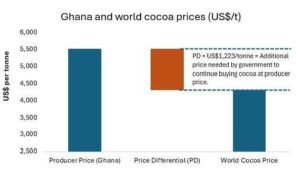 By contrast, the world market price for cocoa is around US$4,300 per tonne (or GH¢45,150 per tonne), which is significantly lower than the price paid to Ghanaian farmers. As a result, the government must spend approximately US$1,223 more per tonne to match the current producer price of US$5,523 per tonne (GH¢3,625 per bag), as illustrated in the attached diagram.
This challenge is partly self-inflicted due to the government’s artificial inducement of the cedi’s appreciation. Unless the cedi weakens or global cocoa prices rise sharply to offset this price differential, it will remain difficult for the government to purchase cocoa at the current rate of GH¢3,625 per bag.
In the worst-case scenario, the government may be forced to lower the producer price—a move that would be unpopular with both the administration and farmers.
The lesson is clear: when the cedi is artificially strengthened, the difficulty in buying cocoa becomes inevitable.
Cocoa farmers, brace yourselves!
About The Author