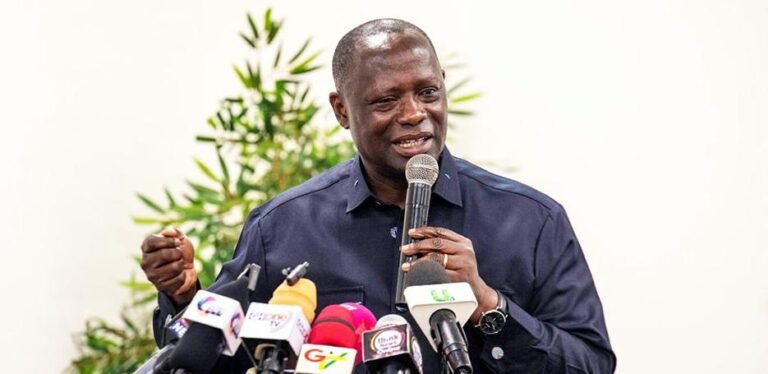
Prof. Isaac Boadi, IERPP Executive Director
The Institute for Economic Research and Public Policy (IERPP) has called on Parliament to urgently summon the Bank of Ghana (BoG) Governor and the Minister of Finance to clarify what it describes as “deeply conflicting official statements” on Ghana’s Gold-for-Oil (G4O) programme.
In a statement signed by its Executive Director, Prof. Isaac Boadi, IERPP said it was “gravely concerned” by the discrepancies between the accounts given by the BoG and the Ministry of Finance on the implementation of the flagship programme.
According to the Institute, the contradictions strike at the heart of public trust in economic governance.
Claims
On March 3, 2025, BoG Governor Dr. Johnson Asiama confirmed that the G4O programme had, indeed, been operational but was suspended “due to policy and operational challenges.” Further clarity was provided on August 11, 2025, when the First Deputy Governor disclosed that 27.63 tonnes of gold were used to settle 1.95 million metric tonnes of petroleum products under the initiative.
However, on July 25, 2025, Finance Minister Dr. Cassiel Ato Forson categorically denied the existence of any barter arrangement, declaring, “there was no barter… never, never”, and insisting that the so-called G4O was “nothing more than conventional dollar payments for oil.”
“These statements cannot both be true. Ghanaians deserve more than contradictory soundbites; they deserve facts,” the Institute stressed.
Questions
IERPP posed a series of pointed questions to both institutions, demanding full transparency. The Institute asked them to confirm the exact dates of the first and last gold-for-oil transactions. It also requested disclosure of the total quantity of gold transferred for oil imports, accompanied by transaction-level records.
Furthermore, the Institute sought an explanation from the Finance Minister regarding the basis for his categorical denial of the programme in light of the Bank of Ghana’s disclosures. It asked whether the Ministry had conducted any audits of the G4O initiative upon assuming office and, if so, to make those reports public.
Lastly, IERPP called for clarity on the real impact of the programme on fuel prices, foreign exchange stability, and the country’s reserves.
The think tank also challenged both the BoG and the Ministry to submit to an “independent forensic audit of the G4O transactions, to be made public” and to appear jointly before Parliament to reconcile their statements.
“The truth must be placed on public record to restore confidence in our economic management. Ghana’s economy cannot run on contradictory press statements. Transparency is not optional; it is the foundation of trust,” the IERPP statement indicated.
IERPP further maintained that only through open disclosure and parliamentary scrutiny could the public be assured that the management of the G4O programme served the nation’s best interest.
The G4O programme
The Gold for Oil (G4O) Programme was an initiative of the Government of Ghana (GoG) to use the existing Bank of Ghana (BoG) Domestic Gold Purchase (DGP) Programme to support the import of petroleum products into Ghana.
The prime objective of the programme was to use additional foreign exchange resources from the BoG’s DGP programme to provide foreign currency for the importation of petroleum products for the country, which currently stands at about USD350 million per month.
That was intended to free up foreign exchange resources to meet petroleum imports of the country, thereby reducing pressures on the BOG’s foreign reserves and the banking sector emanating from the Bulk Import, Distribution and Export Companies’ (BIDECs’) request for foreign exchange.
The programme also aimed to procure petroleum products at very competitive prices through Government-to-Government (G2G) arrangements. The programme was to ensure that the cost of importing the products from international oil traders would always be comparatively lower.
The consequent reduction in foreign exchange pressures, the reduction in premiums charged by international oil traders, as well as efficiency gains from the value chain would translate to lower ex-pump prices in the country.

About The Author