Dr Jeffrey Haynes, Professor Emeritus of Politics, London Metropolitan University, UK
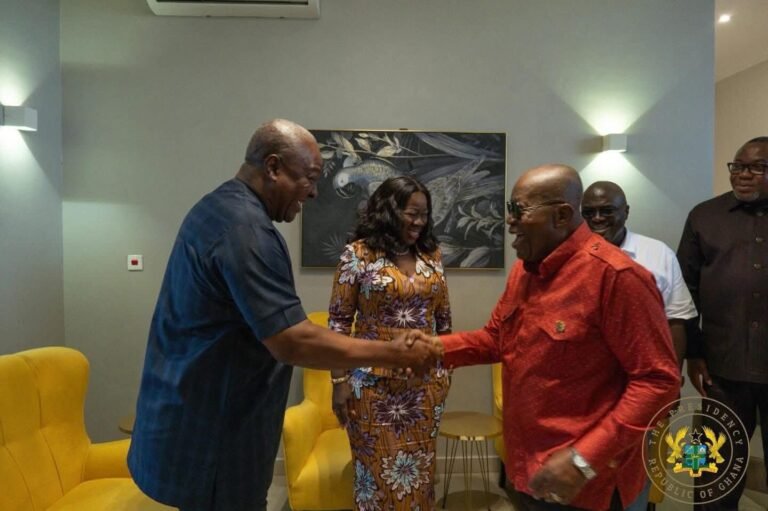
The 2024 presidential election was won resoundingly by John Dramani Mahama, a senior member of the Assemblies of God Ghana (AG). AG is a major Pentecostal Christian denomination, part of the global AG fellowship, characterised by its strong belief in the Bible, Spirit baptism, divine healing, evangelism, and a vibrant, experience-focused worship style, while also actively involved in social development in Ghana.
One of the first acts of President Mahama on taking up office in January 2025 was to appoint a constitutional review committee under the leadership of Professor H. Kwasi Prempeh, Executive Director of the Ghana Center for Democratic Development (CDD-Ghana), a position he has held since February 2018. President Mahama officially inaugurated the 8-member committee team to propose amendments to the 1992 Constitution, with public submissions starting in late February 2025, fulfilling a key campaign promise to strengthen democracy. After months of deliberations, involving multiple meetings with stakeholders throughout Ghana, the committee’s report is soon to be presented to the president. One of the key issues driving the work of the constitutional review committee was the power of the president as set out in the 1992 constitution: does the latter give the former too much? Should the president’s power be curtailed in the interests of democracy?
Many would agree that Ghana’s democracy as currently constituted has significant flaws. The US non-governmental organisation, Freedom House, identifies Ghana’s democratic weaknesses as ‘discrimination against women and LGBT+ people’ and limited ‘judicial independence and the rule of law’. In addition, ‘corruption and public service delivery present challenges to government performance, [while] political violence as well as illegal mining causing destruction to water bodies is a growing concern’.
Many Ghanaians would share Freedom House’s underwhelming view of the quality of democracy in the country. What is conspicuously lacking is a consistently conscientious leadership delivering a national progressive moral vision to fulfil the country’s development aspirations. Some aver in addition that Ghana’s current political leadership is conspicuous by what it lacks: patriotic loyalty, faithfulness, selfless service, integrity, fearless and honesty. For many Ghanaians high-level corruption is a key issue, significantly undermining Ghana’s democracy. Such corruption makes democracy weaker, increases its unrepresentativeness and indicating a lack of transparency.
Ghana’s democracy is also said to suffer from a lack of moral integrity at the highest levels. Many among those in power exploit their position for illicit or illegal personal gain. If Ghana’s democratic institutions were truly representative, accountable and transparent then the quality of democracy would improve. Ruinous corruption would be reduced as people in positions of power would be less tempted to transgress as the fear of being found out would grow. Less corruption at the state-level should mean more financial resources devoted to what most Ghanaians want: better health care, improved education for their children, increased protection from floods, renovation of the country’s transport infrastructure, including roads and the ailing railway network, and so on.
It is most unlikely that Prof. Prempeh’s constitutional review committee will make recommendations regarding moral leadership in Ghana. The committee will instead likely focus its recommendations on revisions or reformation of national political institutions in order to strengthen democracy. On the other hand, morality and democracy are deeply linked in Ghana. Perceived moral decline (especially corruption among elites) is seen as a major threat to democratic quality, which fuels public distrust and discontent.
Awaiting the report of Prof. Prempeh’s committee which, we are told, will be published in full for public edification, the General Superintendent of the Assemblies of God Ghana, Rev. Stephen Yenusom Wengam, has waded in to the debate about the position of morality in Ghana’s democracy. Rev. Wengam has strongly condemned the abuse of power in political circles, the corporate world, workplaces and marital homes, describing it as a tool often used to advance selfish interests or gain undue advantage: ‘In the name of acquiring wealth, attaining political positions, or promotion in the workplace, some people use all sorts of wicked means to mistreat or eliminate their perceived enemies. This is what King Herod attempted against baby Jesus, and such crude methods we must eschew as political leaders or private individuals’.
Rev. Wengam expressed these ideas during the sermon he delivered on the Forecourt of the State House in Accra on 18 December as part of the Festival of Nine Lessons and Carols hosted by Parliament. Political leadership, he said, must pursue a national vision that transcends narrow partisan considerations. Such a vision must be backed by strong moral values as a critical compass for holistic development. Rev. Wengam reminded the audience that the then-powerful Roman Empire fell apart because of what he referred to as ‘moral failure, particularly sexual immorality, and such failure must not be repeated by the present generation’. Finally, Rev. Wengam urged the government, Parliament and other state institutions to do more to protect human rights and advance the interests of Ghanaians.
The thoughts of Rev. Wengam and the likely findings of the constitutional review committee point in different directions. Religious leaders, such as Rev. Wengam, invoke perceived religious/cultural values (such as honesty and accountability) to demand improved governance. Others believe that institutional reform is crucial for translating moral pressure into democratic improvements. Key tensions involve religious influence potentially clashing with secular democracy on issues like which societal groups should enjoy human rights, as well as the gap between espoused ethics and corrupt practices. What is needed is improved moral norms among the politically powerful coupled with meaningful institutional reforms to protect and enhance Ghana’s democracy.
The writer is an Emeritus Professor of Politics at London Metropolitan University, UK.
About The Author