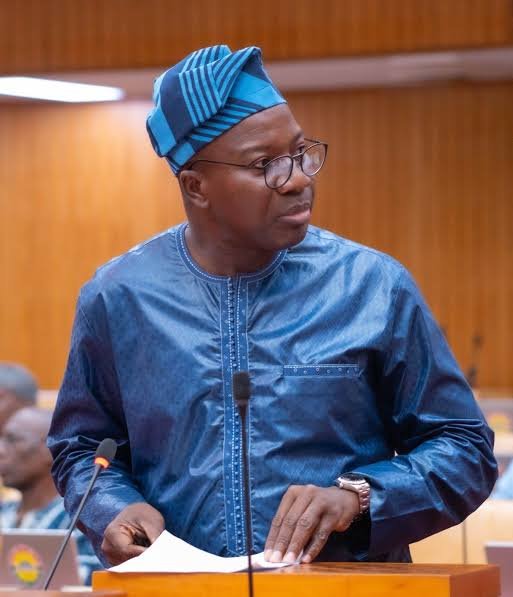
By Rev. Immanuel Wiafe – Special Correspondent
Credit: Channel One TV & Channel One News
Parliament brought its recent session to a close with what many expected to be a routine address. But instead, Ghana’s airwaves, civic discussions, and political discourse have been shaken by a bold and deeply controversial statement from Majority Leader, Hon. Mahama Ayariga. In his concluding remarks as Parliament rose, Ayariga claimed that many Ghanaians are calling for a third term for President John Dramani Mahama due to what he described as the President’s excellent performance in office.
According to him, it is the people themselves who are making this demand, and not the ruling administration. He emphasized that if such a decision ever materializes, it will ultimately rest in the hands of the citizens. To some ears, this sounded like political excitement an expression of admiration for a sitting president. To others, especially constitutional guardians and democratically sensitive citizens, it sounded like an alarming flirtation with constitutional disruption.
And understandably so.
Because Ghana’s laws are clear. The spirit of our democracy is clear. The foundation of our Republic is clear. And the 1992 Constitution leaves no room for ambiguity: a President is entitled to only two terms in office.
A STATEMENT THAT LEAVES THE NATION UNEASY
Hon. Ayariga’s words cannot be brushed aside as harmless political commentary. They come not from an ordinary party activist, social commentator, nor casual citizen but from the Majority Leader of Parliament, a key custodian of our legislative integrity. When such a person deliberately or inadvertently speaks in ways that appear to undermine or stretch constitutional limits, the nation must not remain silent.
The statement is worrying for several reasons.
First, it plants unnecessary confusion in the minds of citizens. When a senior lawmaker publicly entertains the possibility of a third term for a sitting president, he indirectly suggests that the Constitution is flexible on this matter or that public excitement is sufficient justification to circumvent constitutional order. Ghana has witnessed what happens in other African countries when politicians begin to “test” constitutional boundaries. We have seen chaos erupt in nations where leaders sought term extensions. We have seen political instability, violence, distrust, and national breakdown simply because leaders refused to respect democratic limits.
Do we want Ghana to walk that dangerous path?
Secondly, Ayariga’s statement appears to trivialize the solemnity of Ghana’s Constitution. Laws are not emotional instruments that bend to popularity or excitement. They are the anchors of national order. When leaders begin to speak as though legal provisions exist to be experimented with when convenient, they weaken the democratic consciousness of the nation.
The Constitution is our Bible of governance. It is the nation’s Quran of order. It is the covenant between the State and citizens. It is our collective social contract.
So the question that must be asked, respectfully but firmly, is this:
What exactly does Hon. Ayariga believe such a statement contributes to Ghana’s development?
How does this advance economic growth?
How does this stabilize our democracy?
How does this strengthen institutions?
Or does it only stir excitement among a few while risking confusion among many?
A MORAL AND LOGICAL QUESTION BACK TO THE MAJORITY LEADER
If Hon. Mahama Ayariga truly believes that public desire is enough justification to test constitutional boundaries, then would he also accept it if citizens wake up tomorrow and declare that the Bible or Quran he reads is wrong and that acting contrary to Scripture should suddenly be seen as right?
Would he submit morality to popular emotion?
Should we declare spiritual truth invalid simply because some people feel differently?
Truth does not bend to excitement.
Principle does not submit to applause.
Law does not change because passion rises.
If citizens tomorrow claim that stealing public funds is acceptable because it “benefits supporters,” should we legalize it? If some people demand that adultery or violence be celebrated rather than condemned, should society alter morality to accommodate them?
Certainly not.
In the same way, constitutional provisions cannot be subjected to emotional experimentation or political enthusiasm. Ghana is bigger than political convenience. Ghana is greater than partisan excitement. The Republic must not be gambled with.
A DIRECT CHRISTIAN APPEAL TO PRESIDENT JOHN DRAMANI MAHAMA
This conversation becomes even more sensitive and spiritually weighty because President John Dramani Mahama is not just a political leader; he is a publicly professing Christian. He has repeatedly affirmed his faith. He has spoken of his Christian identity in churches, national platforms, and international gatherings. And Christianity is not merely a religious label. It is a moral commitment to righteousness, integrity, obedience to lawful authority, and respect for order.
The Bible states clearly that Christians must respect and submit to lawful governance structures (Romans 13:1–2). Scripture emphasizes integrity, humility, and accountability. A Christian leader should never be associated with illegality, constitutional manipulation, or power ambition beyond lawful bounds.
So if ever President Mahama is tempted to listen to such calls let this be a brotherly reminder from one Christian to another:
Sir, do not stain your Christian testimony.
Do not soil your spiritual credibility.
Do not become the leader whose name becomes attached to constitutional disobedience.
When your time is up-and indeed, the Constitution already defines time kindly step down peaceably, honorably, and gracefully, to the glory of God and the respect of the nation.
Do not allow history to record that under your leadership, Ghana began flirting with the violation of term limits. Do not give reason for future generations to link your name with the erosion of constitutional integrity. Do not allow your faith to be questioned because of political ambition.
For Christians are law-abiding. Christians respect covenantal agreements. Christians protect peace.
A Christian leader must never become a channel through which instability enters a nation.
THE LAW SPEAKS CLEARLY — TWO TERMS ONLY
There is no theological controversy here.
There is no constitutional debate here.
There is no intellectual confusion here.
Ghana’s governing framework has settled the matter:
A President shall serve two terms-and only two terms.
No debate.
No test of strength.
No experimentation.
No manipulation.
This clause was designed deliberately to protect Ghana. It exists to prevent power intoxication. It prevents dictatorship. It prevents emotional governance. It safeguards political sanity.
Tampering with it is like tampering with the foundation of a building. You may not see the crack immediately, but collapse is inevitable.
LEADERSHIP REQUIRES RESTRAINT, NOT EXCITEMENT
Good leadership is not defined only by performance. It is also defined by restraint. Great leaders know when to let go. They know when to step aside gracefully. They know that legacies are not only about what you build while in office, but also how you leave office.
If President Mahama truly desires lasting honour, he must ensure that his name becomes synonymous with democratic maturity, not constitutional experimentation. Let him be remembered as the leader who respected law, not the one who allowed ambition to whisper beyond lawful boundaries.
A CALL TO RESPONSIBILITY FOR LEADERS AND SUPPORTERS
To political leaders: do not use influence to confuse the public. Guard the Constitution as sacred. Your words carry power; use them to stabilize, not destabilize.
To believers: let us pray for our leaders, but also speak truth when necessary. Christian faith demands both prayer and prophetic accountability.
To citizens: remain vigilant. Do not allow excitement or loyalty to blind you to truth. No leader, no matter how admired, must stand above the law.
FOR THE PEACE AND FUTURE OF GHANA
Ghana remains one of Africa’s shining democratic examples. We cannot take that glory for granted. Many nations envy our peace. Many admire our electoral transitions. Many study our democratic culture. Let us not destroy what God has blessed us with simply because of political emotion.
Our children must inherit a nation where laws are respected, institutions remain strong, and leadership honors boundaries.
Let President Mahama govern well today.
Let the Constitution speak tomorrow.
And when time calls for exit, let him walk away with dignity not controversy.
For Ghana is bigger than any individual leader. Ghana is greater than political excitement. And Ghana’s peace is worth more than any third-term dream, no matter how beautifully packaged.
Let wisdom prevail.
Let law stand firm.
Let Ghana live on in peace.
About The Author