By Bright Philip Donkor
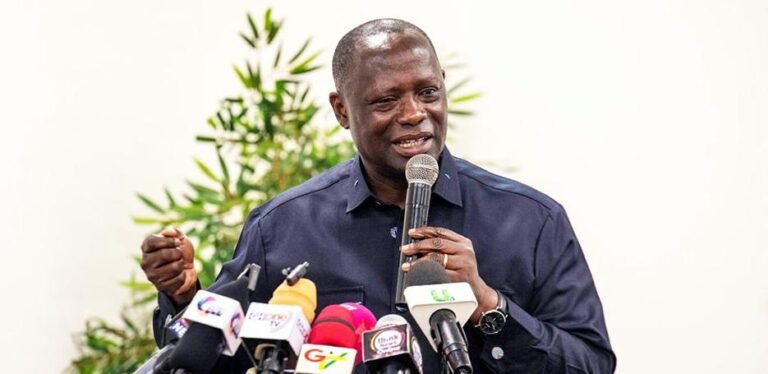
The Minister of Health, Kwabena Mintah Akandoh, has officially sworn in new Boards for six major health regulatory bodies, urging them to drive urgent reforms across Ghana’s healthcare landscape and deliver on the promise of accessible, equitable, and quality health services for all.
At a ceremony held at the Ministry’s auditorium, Accra, the Minister administered the oath of office to newly constituted Boards of the Mental Health Authority, Ghana College of Pharmacists, Allied Health Professions Council, National Ambulance Service, Traditional Medicine Council, and the National Blood Service.
The Minister also announced the appointment of the following distinguished individuals as Chairpersons for the respective Boards and Councils: Dr. Emmanuel Maurice Ankrah for the National Blood Service Board, Dr. Dan Bazanndut for the Mental Health Authority Board, Prof. Francis Ackah Armah for the Ghana College of Pharmacists Council, Prof. Eric Kotei Addison for the Allied Health Professions Council, and Prof. Ato Duncan for the Traditional Medicine Practice Council.
Pivotal role
The Health Minister emphasised the pivotal role of regulatory institutions in shaping a health system anchored on professionalism, trust, and public accountability. “Today’s event is a collective statement that regulation matters,” he said. “Oversight, standards, and systems are not optional; they are the foundation on which safe, equitable, and trusted healthcare is built.”
The Minister revealed that over 2.3 million Ghanaians are currently living with mental illness, yet only around 2% receive formal psychiatric care. He described the treatment gap as both a national crisis and an opportunity for transformation. “We can no longer afford to treat mental health as secondary. This Board must lead the charge to expand access, integrate services, and confront stigma head-on,” he said.
Turning to the Ghana College of Pharmacists, the Minister lamented the country’s severe shortage of trained pharmacists—less than 20 per 100,000 population, far below global benchmarks. He called on the Board to scale up professional training and leadership within the sector. “As Ghana pursues pharmaceutical self-reliance, we will need pharmacists trained not just in dispensing, but in formulation, regulatory compliance, and quality control,” he stressed.
The Allied Health Professions Council, he noted, must prioritise regulation and development for often-overlooked professionals such as radiographers, laboratory scientists, nutritionists, and physiotherapists. These, he said, form “the invisible backbone of healthcare delivery” and must be empowered to meet the demands of modern diagnostics and therapeutic care.
Ambulance services
With over 350 ambulances and 3,400 emergency personnel currently in operation, the Minister acknowledged improvements in Ghana’s emergency response system but lamented slow response times, averaging 17 minutes, more than double the WHO standard. He charged the National Ambulance Service Board to restore public trust through operational reform. “We are overhauling not just the fleet, but the entire culture. Ghanaians must know that help will come, promptly, when they call,” he added.
Highlighting that up to 70% of Ghanaians use traditional medicine as their primary source of care, the Minister urged the Traditional Medicine Council to regulate, professionalise, and integrate indigenous practices within a national health framework. “This is not an argument against modern medicine. It is a call to regulate what people already trust and use,” he said.
Blood deficit
The National Blood Service Board was reminded of the critical blood shortfall facing the country. In 2024, only 190,000 units of blood were collected against a national requirement of over 300,000. The Minister said that only a quarter of donations come from voluntary donors, threatening the sustainability of the national blood supply. “The solution lies in building a culture where blood donation becomes a civic responsibility and national norm,” he said.
The Minister called on all six Boards to view their mandates as a call to leadership, not merely oversight. He encouraged collaboration across agencies, data-driven decision-making, and patient-centred thinking. “We will support you with policy and systems but we also expect results. Regulation is not about paperwork; it’s about saving lives,” he said.
About The Author