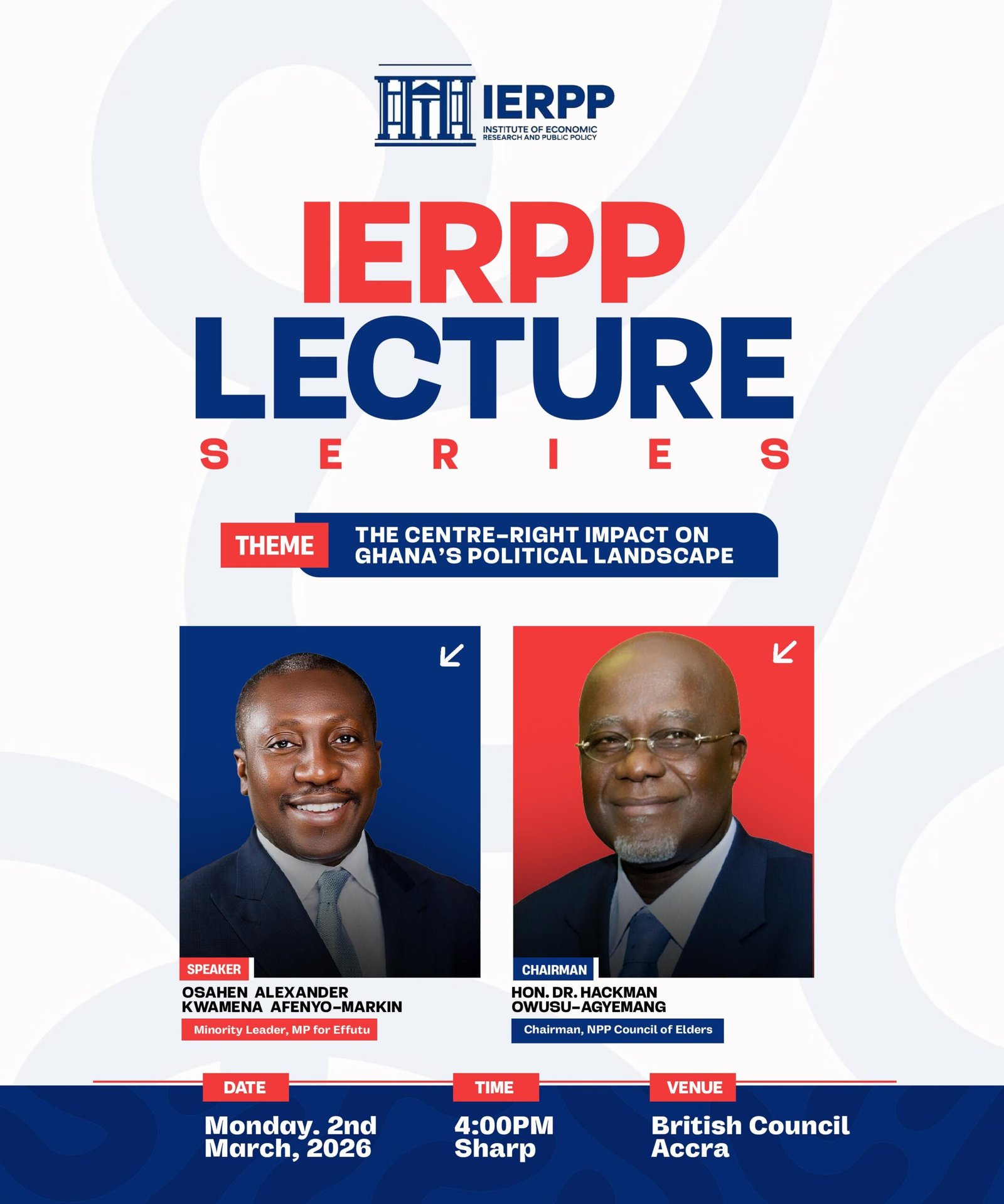
The Institute for Economic Research and Public Policy (IERPP) is set to host the maiden edition of its Lecture Series with a focus on the impact of centre-right ideology on Ghana’s political and policy landscape.
The lecture, scheduled for Monday, March 2, 2026, at 4:00 p.m. at the British Council in Accra, will be delivered by Osahen Alexander Kwamena Afenyo-Markin, the Minority Leader and Member of Parliament for Effutu.
Announcing the event, Professor Isaac Boadi, Executive Director of IERPP, indicated that the lecture would critically examine the historical evolution and contemporary relevance of centre-right politics in Ghana’s democratic dispensation. According to him, the session is designed to provide participants with a deeper understanding of how ideological traditions shape governance outcomes, economic management, and public policy choices.
He explained that the discussion will explore how centre-right principles — including fiscal discipline, private sector-led growth, and market-oriented reforms — have influenced political debates and policy directions over the years. The lecture is also expected to assess how such ideological orientations continue to inform electoral dynamics and national development strategies.
In Ghana’s context, centre-right politics has often been linked to the policy philosophy of the New Patriotic Party, which has historically championed economic liberalization, entrepreneurship, and infrastructure development as drivers of growth. These policy approaches have shaped national conversations around trade, investment, and job creation.
Professor Boadi noted that at a time when Ghana faces pressing economic challenges — including inflationary pressures, fiscal consolidation, and sustainable development concerns — revisiting the ideological foundations of governance has become even more crucial. He added that the lecture will provide a platform for students, academics, policy analysts, and political actors to engage in informed and constructive dialogue.
The IERPP Lecture Series is expected to become a recurring platform for rigorous intellectual engagement on key political and economic issues affecting the country. Monday’s event marks the beginning of what the Institute describes as a sustained effort to deepen ideological literacy and policy discourse in Ghana.
About The Author