Islamic scholar, academic, politician and former Minister of State, Shaykh Dr. Mustapha Abdul-Hamid
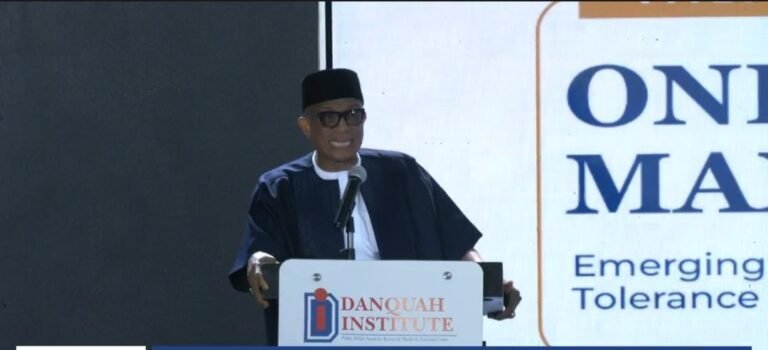
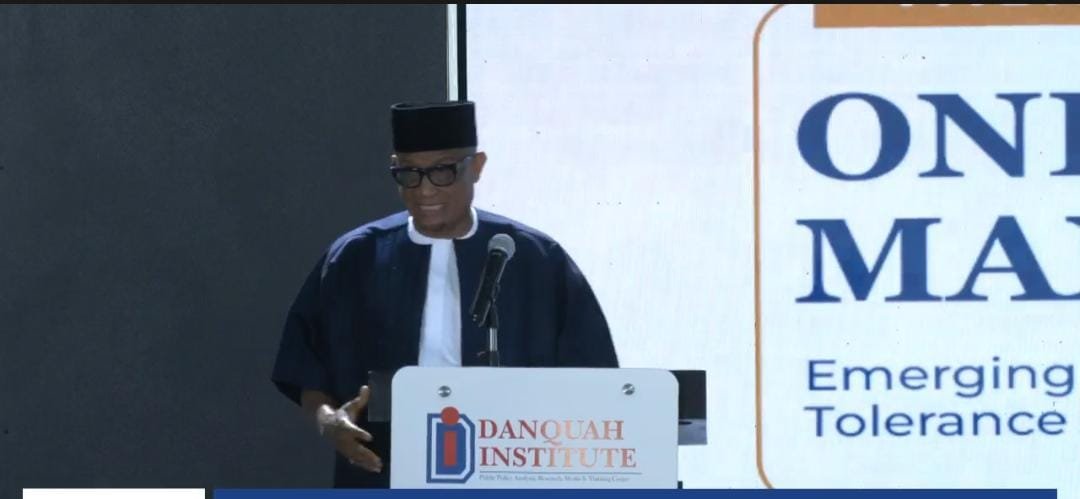
Islamic scholar, academic, politician and former Minister of State, Shaykh Dr. Mustapha Abdul-Hamid, has pointed to Dr. Mahamudu Bawumia’s performance in the 2024 general election as evidence that Ghanaian voters did not vote strictly along religious lines.
He made the comment during the 2026 Liberty Lecture Series of the Danquah Institute at Alisa Hotel on Tuesday, August 25, 2026, under the theme “One Nation, Many Faiths: Emerging Threats to Religious Tolerance in Ghana”.
According to Abdul-Hamid, Bawumia, a Muslim, secured more votes than some of the Christian parliamentary candidates who contested alongside him in constituencies where the New Patriotic Party (NPP) had fielded candidates, demonstrating that his support extended beyond religious considerations.
He cited Assin South as the most prominent example, saying Bawumia obtained more votes than the NPP’s parliamentary candidate, whom he described as a Christian and “a Minister of the gospel.”
“The most prominent one being Assin South, where he beat his parliamentary candidate, who is a Minister of the gospel,” Abdul-Hamid said.
Abdul-Hamid said Bawumia’s performance in such constituencies was significant in assessing claims that Muslims in Ghana were pursuing a collective political agenda to install a Muslim president as part of an attempt to Islamise the country.
He argued that if Ghanaian Muslims had been driven by a coordinated religious agenda, the 2024 election would have provided an opportunity for them to rally overwhelmingly behind Bawumia because of his Muslim identity.
“Were such an agenda to exist, the candidacy of Mahamudu Bawumia would have been the catalyst, and his candidature would have been the opportunity for Muslims to rally round it,” Abdul-Hamid said.
He said the actual voting pattern, however, did not support such a conclusion.
“The fact that Muslims in 2024 did not rally wholesale behind a Muslim candidate shows that no such agenda exists,” Abdul-Hamid said.
He cited Muslim-dominated constituencies including Ayawaso East, Ayawaso North, Asawase, Ejura, Tamale North, Tamale Central, Tamale South and Sagnarigu, which he said voted massively for John Dramani Mahama, a Christian, rather than Bawumia.
Abdul-Hamid said the voting pattern demonstrated that religious identity was not the determining factor in the political choices of Ghanaian Muslims.
He also rejected suggestions that Bawumia’s presidential ambition was motivated by a desire to alter Ghana’s religious character, saying the former Vice President’s background and professional career showed a sustained focus on economics and national development.
“Mahamudu Bawumia is not seeking the presidency of Ghana to re-order the religious destiny of our country,” Abdul-Hamid said.
He said Bawumia’s education and professional experience, from Zimbabwe and Oxford University to the Bank of Ghana and the Vice Presidency, had centred on economics and the development of solutions to improve the health of economies and nations.
“Throughout his education and training, he has studied economics,” Abdul-Hamid said.
He further cited initiatives associated with Bawumia’s tenure as Vice President, including medical drone delivery, national identification and the gold purchase programme, saying they had benefited Ghanaians regardless of their religious affiliation.
“As a vice president, his far-reaching propositions – medical drone delivery, national identification and the gold purchase programme have benefited every Ghanaian irrespective of religious affiliation,” Abdul-Hamid said.
Abdul-Hamid also referred to the nickname “Walewale Adam Smith”, which he said Bawumia’s political opponents had used to describe him, arguing that the comparison reflected the former Vice President’s focus on economic issues rather than religious transformation.
“Adam Smith, we all know, was in the business of propounding theories for the health and wealth of nations, not re-ordering the theological destinies of nations,” Abdul-Hamid said.
He said the 2024 election results should therefore be considered when assessing claims that Ghana faces a coordinated political agenda to Islamise the country.
About The Author