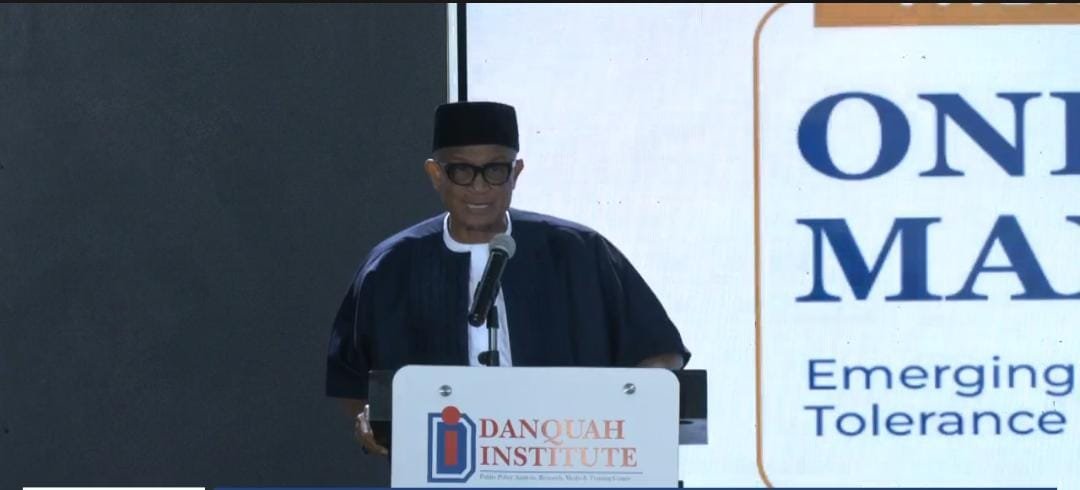
Islamic scholar, academic, politician and former Minister of State, Shaykh Dr. Mustapha Abdul-Hamid
Islamic scholar, academic, politician and former Minister of State, Shaykh Dr. Mustapha Abdul-Hamid, has dismissed suggestions that Dr. Mahamudu Bawumia’s political ambition is linked to an agenda to Islamise Ghana, saying the former Vice President’s record and professional background point instead to a sustained focus on economic development.
He said this during the 2026 Liberty Lecture Series of the Danquah Institute at Alisa Hotel on Tuesday, August 25, 2026, under the theme “One Nation, Many Faiths: Emerging Threats to Religious Tolerance in Ghana”.
Dr. Abdul-Hamid said Bawumia’s education and career had largely revolved around economics and the search for solutions to the economic challenges confronting nations, rather than attempts to alter Ghana’s religious identity.
“Mahamudu Bawumia is not seeking the presidency of Ghana to re-order the religious destiny of our country,” Abdul-Hamid said.
He said Bawumia’s professional journey, from his education in Zimbabwe and at Oxford University to his work at the Bank of Ghana and later service as Vice President, demonstrated that his principal area of expertise and public engagement had been economics.
“Throughout his education and training, he has studied economics,” Abdul-Hamid said.
He said Bawumia’s work in public office had produced policy initiatives that were intended to benefit Ghanaians irrespective of their religious affiliations, citing medical drone delivery, national identification and the gold purchase programme among his major propositions.
“As a vice president, his far-reaching propositions – medical drone delivery, national identification and the gold purchase programme have benefited every Ghanaian irrespective of religious affiliation,” Abdul-Hamid said.
Abdul-Hamid also pointed to a nickname given to Bawumia by his political opponents, arguing that the description itself captured the former Vice President’s reputation as an economist and policy thinker.
“Dr. Bawumia’s political opponents have themselves nicknamed him, ‘Walewale Adam Smith,’” Abdul-Hamid said.
He drew a comparison between Bawumia and Adam Smith, the Scottish economist widely associated with foundational ideas on economics and wealth creation, saying the nickname was significant because Smith’s intellectual work focused on the economic wellbeing of nations.
“Adam Smith, we all know, was in the business of propounding theories for the health and wealth of nations, not re-ordering the theological destinies of nations,” Abdul-Hamid said.
He therefore argued that Bawumia’s political and professional record did not provide a basis for claims that his ambition to become President of Ghana was driven by religious considerations.
Abdul-Hamid said the former Vice President should instead be assessed on his economic ideas, policy proposals and contribution to national development rather than his religious identity.
He further argued that the voting pattern in the 2024 general election weakened claims that Ghanaian Muslims were pursuing a coordinated political agenda to install a Muslim president for the purpose of Islamising the country.
“The fact that Muslims in 2024 did not rally wholesale behind a Muslim candidate shows that no such agenda exists,” Abdul-Hamid said.
About The Author