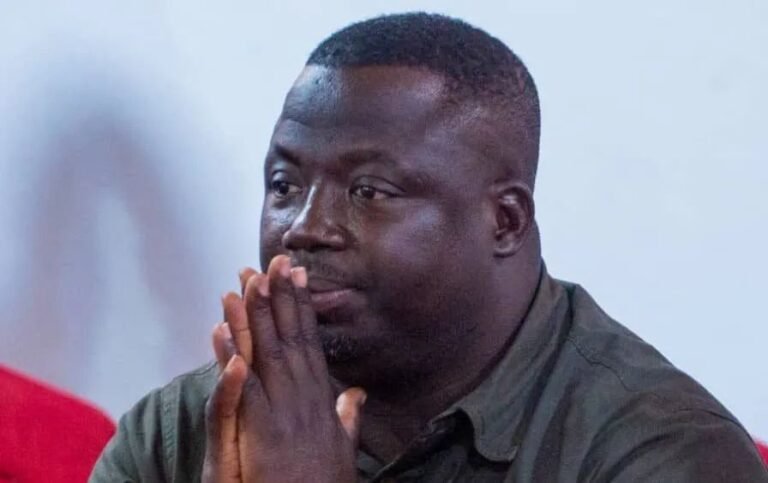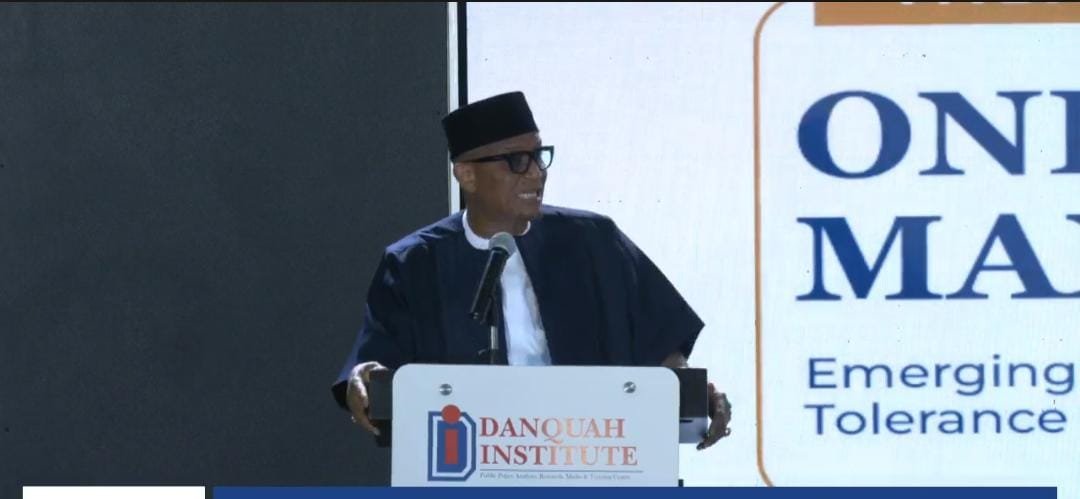
Islamic scholar, academic, politician and former Minister of State, Shaykh Dr. Mustapha Abdul-Hamid, has dismissed suggestions that President John Dramani Mahama’s proposal to standardise and introduce the optional study of Arabic at the basic school level forms part of an agenda to Islamise Ghana.
He made the remark during the 2026 Liberty Lecture Series of the Danquah Institute, held at the Alisa Hotel on Tuesday, August 25, 2026, under the theme, “One Nation, Many Faiths: Emerging Threats to Religious Tolerance in Ghana.”
According to Abdul-Hamid, the proposed Arabic policy should not be interpreted through a religious lens, arguing that Mahama’s Christian faith and public record provide no basis for claims that the President intends to use Arabic education to promote Islamisation.
“I am very clear in my mind that President John Dramani Mahama, in proposing the standardization and optional study of Arabic at the basic level and the introduction of interest-free banking, does not intend to Islamize Ghana,” Abdul-Hamid said.
He said he found it difficult to understand how Mahama could be accused of endorsing an Islamisation agenda when the President is a Christian who believes in the Christian faith and belongs to the Assemblies of God Church.
“President Mahama believes in the saving grace of Christ and is a member of the Assemblies of God Church,” Abdul-Hamid said.
“How anybody will conceive that he would endorse an agenda to Islamize Ghana beats my imagination,” he added.
Abdul-Hamid argued that Arabic should be viewed primarily as a language with significant educational, economic and diplomatic value rather than being treated as synonymous with Islam.
“Arabic is a language separate and distinct from Islam,” Abdul-Hamid said.
He said the introduction of Arabic alongside Mandarin demonstrated the broader objective of equipping Ghanaian children with languages that could enhance their ability to participate in the global economy and engage with different parts of the world.
“Introducing Arabic as a subject of study is essential to producing global citizens,” Abdul-Hamid said.
He questioned how Ghana could expect to produce globally competitive citizens while refusing to equip young people with languages that have important roles in international commerce and diplomacy.
“How do we hope to produce global citizens by refusing to learn the languages of commerce and diplomacy?” Abdul-Hamid said.
He said Arabic was widely spoken across Africa and internationally, making its acquisition potentially beneficial to Ghanaian students and professionals.
Abdul-Hamid also rejected attempts to ground the teaching of Arabic solely in religion, pointing out that Arabic is spoken by both Muslims and Christians.
“For those who want to ground the proposal to study Arabic in religion, it is important to state that Arab Christians speak Arabic and refer to God as Allah and Lord as Rabb exactly as Muslims use them,” Abdul-Hamid said.
He cited Arab Christians’ use of Arabic in Christian worship as further evidence that the language should not be regarded as the exclusive preserve of Muslims.
Abdul-Hamid also pointed out that several of the world’s largest Muslim-majority countries do not speak Arabic, citing Indonesia, Pakistan, India, Bangladesh and Nigeria.
He said this further demonstrated that Arabic and Islam were not interchangeable concepts.
Abdul-Hamid said Ghana could also derive significant economic benefits from developing Arabic language skills among its young population because of the size and growing importance of Arab markets.
“In my view, learning Arabic in Ghana should be seen not merely as a religious pursuit, but increasingly as a strategic socio-economic investment,” Abdul-Hamid said.
He said the 22 member states of the Arab League collectively represented an economic bloc with an output of more than $4 trillion, while their growing investments in energy, infrastructure, aviation, finance and technology were making them increasingly important partners for sub-Saharan Africa.
According to Abdul-Hamid, proficiency in Arabic could open opportunities for Ghanaian students, diplomats, entrepreneurs and professionals in education, employment, trade and investment.
“Arabic proficiency can therefore open doors for Ghanaian students, diplomats, entrepreneurs, and professionals to scholarships, employment, trade, and investment opportunities across this vast market,” Abdul-Hamid said.
About The Author