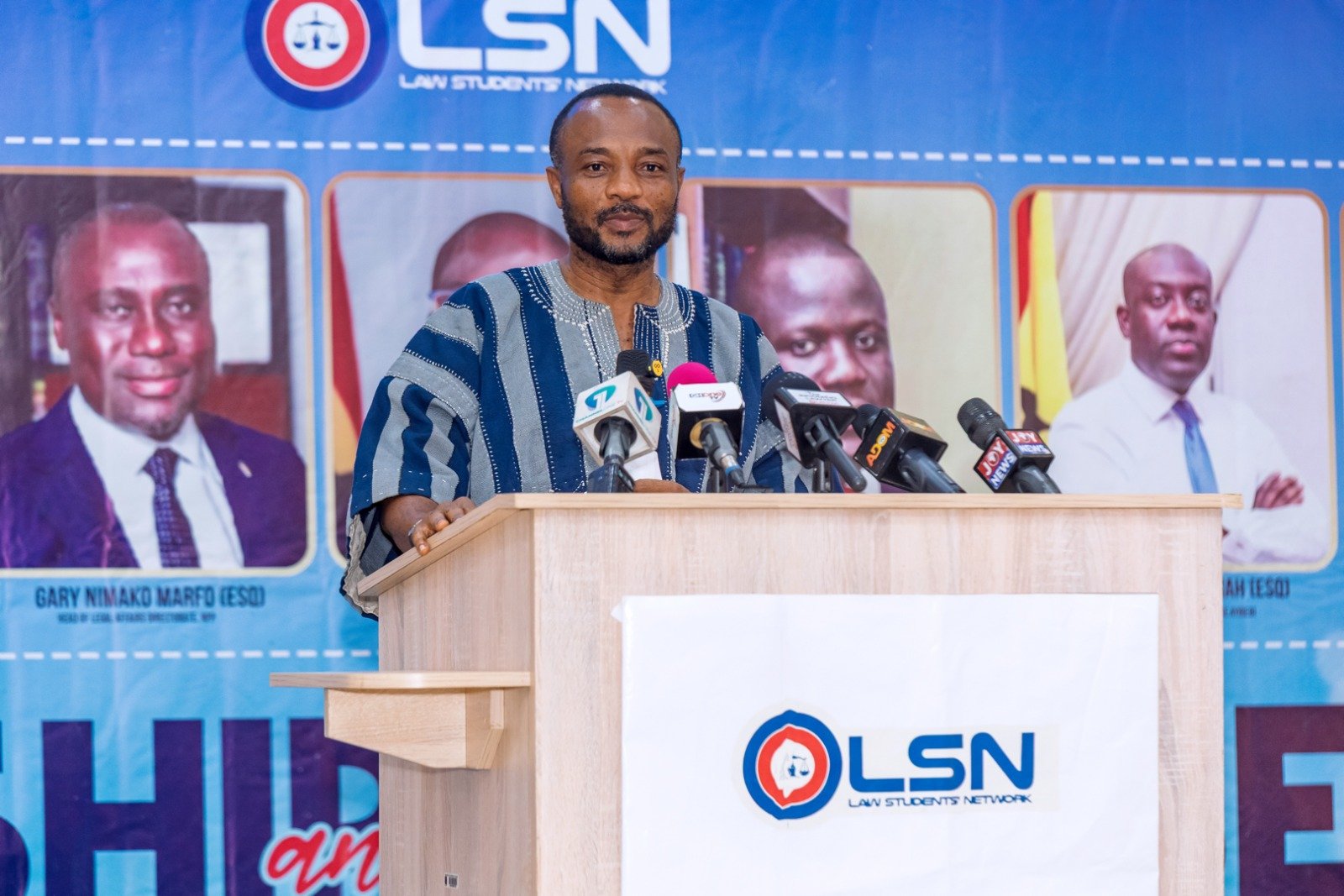
The Second Deputy Minority Chief Whip, Jerry Ahmed Shaib, has urged law students and young professionals to prioritise integrity, discipline, and character development as key foundations for leadership in law, governance, and public service.
He made the remarks while speaking on behalf of the Minority Leader, Osahen Alexander Kwamena Afenyo-Markin, at the 2026 Law Students’ Network (LSN) Leadership and Law Series held on Saturday, April 18, 2026, at the ISSER Conference Centre, University of Ghana, Legon. The event was held under the theme, “Beyond the Classroom: Winning in Law and Politics”.
Mr. Shaib, who is also the Member of Parliament for Weija-Gbawe, stressed that governance and leadership are ultimately shaped by the conduct of individuals who operate state institutions.
He noted that while Ghana has established strong constitutional and institutional frameworks, their effectiveness depends largely on the people who run them. “Governance institutions can only deliver if the individuals who run them possess integrity, discipline and conviction,” he stated, adding that without such values, even the strongest constitution could falter.
He further indicated that the future of governance depends on the preparation of the younger generation, particularly in terms of character and responsibility. According to him, the quality of leadership in the country will be determined by how well young professionals are shaped in both knowledge and conduct.
Mr. Shaib also emphasised the importance of the theme of the programme, “Beyond the Classroom: Winning in Law and Politics,” describing it as a challenge to the belief that academic qualifications alone guarantee success in public life.
He explained that while academic training provides knowledge of statutes and case law, it is character and preparation that determine how effectively such knowledge is applied in real-life governance and decision-making. He cautioned that there will be moments in law and politics where individuals must act on principle rather than convenience.
He told the gathering that true leadership requires courage, especially in situations where silence or inaction may be easier but unjust. He noted that accountability and ethical decision-making remain central to both legal practice and political leadership.
Turning to broader reflections on governance and political tradition, Mr. Shaib referenced the “Danquah-Dombo-Busia Tradition,” which he links to principles of constitutionalism, accountability, and democratic governance.
He explained that the tradition represents a political and ideological heritage that promotes the rule of law, individual liberty, economic freedom, and leadership anchored in integrity. He added that it also emphasises property-owning democracy and broad-based economic participation.
Mr. Shaib further reiterated that constitutional democracy rests on key pillars such as the rule of law, freedom of speech, equality before the law, and multi-party governance. He stressed that no individual or authority is above the law, citing the principle that “be ye never so high, the law is above all good.”
He also highlighted the importance of civil liberties, including freedom of expression, assembly, and the press, describing them as essential tools that enable citizens and legal professionals to hold government accountable.
According to him, economic freedom and private enterprise remain central to national development, arguing that political liberty is strengthened when citizens are able to own property and benefit from their labour.
Mr. Shaib further encouraged law students to see themselves as future custodians of Ghana’s democratic and legal order, urging them to combine academic knowledge with discipline, ethical conviction, and a strong sense of national responsibility.
About The Author