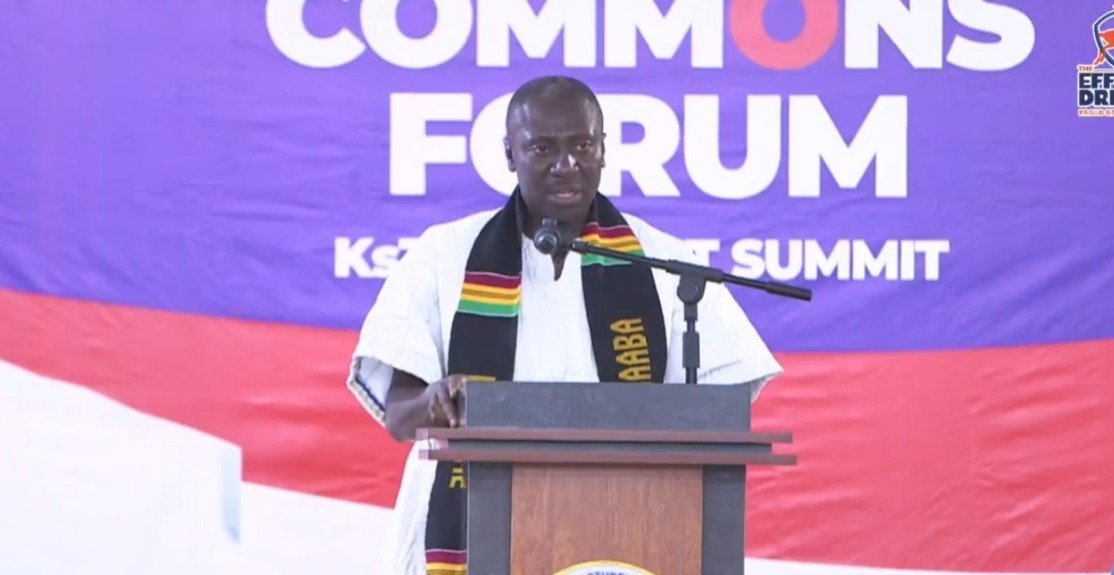
Minority Leader of Parliament and Member of Parliament for Effutu Constituency, Osahen Alexander Kwamena Afenyo-Markin, has underscored what he describes as a continuous ideological thread running through the New Patriotic Party’s (NPP) tradition, arguing that from the era of Dr. J. B. Danquah to the contemporary leadership of Dr. Mahamudu Bawumia, the party has remained anchored in a consistent philosophy of development and governance.
Speaking at the Young Commons Forum (YCF) of the Kwame Nkrumah University of Science and Technology (KNUST) and Kumasi Technical University (KsTU) on Saturday, 20th June 2026, under the theme, “Honouring the Foundations, Building the Future: The Danquah–Dombo–Busia Legacy as a Blueprint for Modern Prosperity,” Osahen Afenyo-Markin said the ideological foundations laid by the founding figures have not been altered by time, but rather adapted to meet the evolving needs of successive generations.
He noted that at the heart of this tradition is a sustained commitment to “promoting property ownership, unity, democratic welfare, social protection, educational access, industrialisation and digital transformation,” which he described as “one enduring vision adapted to each era’s challenges.”
According to him, the idea of a “property-owning democracy,” first articulated in the early ideological formation of the tradition, continues to guide the party’s policy direction in both social and economic governance. He stressed that whether in education reform, healthcare expansion, or digital policy innovation, the underlying objective has always been to empower individuals to build sustainable livelihoods.
Afenyo-Markin further argued that the tradition’s emphasis on unity and inclusion remains a defining feature of the NPP’s identity, insisting that its political philosophy has consistently sought to transcend ethnic and regional divisions in favour of national cohesion and equal opportunity.
He maintained that the modern emphasis on digital transformation and industrialisation represents a natural evolution of the same founding ideals, repositioned for a 21st-century economy driven by technology, innovation and global competitiveness.
About The Author