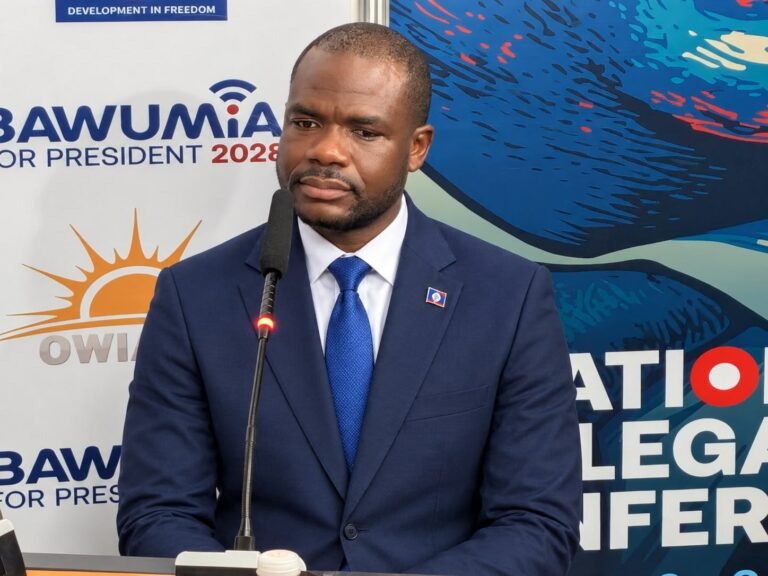
Managing Director of Ghana Water Limited (GWL), Adam Mutawakilu
The Managing Director of Ghana Water Limited (GWL), Adam Mutawakilu, has announced the launch of a 24-month Catchment Recovery Plan aimed at restoring Ghana’s major river bodies and stabilising the country’s treated water production systems. The plan, he said, seeks to tackle the growing menace of siltation, which is rapidly reducing the capacity of raw-water sources and threatening sustainable water supply nationwide.
Speaking at a press conference in Accra on Monday, October 20, 2025, Mr. Mutawakilu lamented that “Ghana’s raw-water sources are silting up faster than our plants were built to handle,” warning that if urgent action is not taken at the source, the country would “spend more each year to produce less water.”
He explained that the Catchment Recovery Plan would focus on eight priority river bodies feeding key treatment plants. The initiative will combine riverbank stabilisation, re-vegetation at erosion hotspots, targeted survey-led dredging around intake channels, and coordinated community engagement to protect riparian buffers.
“We propose an upstream solution — a joint 24-month Catchment Recovery Plan focused on eight priority river bodies feeding our plants. This plan combines riverbank stabilisation, targeted dredging, and coordinated land-use compliance to protect riparian zones,” he stated.
The GWL boss said the project was not only an environmental necessity but also a financially prudent intervention to reduce long-term operational costs.
“Targeted upstream work will restore abstraction capacity, reduce treatment challenges, lower specific energy per cubic metre, and extend asset life by cutting abrasive wear,” he explained.
Rising cost of siltation / emergency dredging
Mr. Mutawakilu disclosed that GWL spent over GHS 77 million in the past year alone on emergency dredging operations at Owabi and Mampong to keep abstraction channels open. “At Owabi last year, dredging cost about GHS 64 million; at Mampong, about GHS 13.8 million,” he revealed, describing the interventions as necessary but disruptive to supply continuity.
He added that siltation “breaks the system in several ways,” affecting operations, chemistry, mechanics, and energy consumption. “We face more frequent shutdowns, filters clog faster, pumps wear out prematurely, and energy use rises sharply because silt-laden water pushes pumps outside their efficient range,” he elaborated.
The worst-affected systems, according to him, include treatment plants in the Eastern Region (Anyinam, Kibi, Osino, Akim Oda, Nsawam), Central and Western Regions (Daboase, Sekyere Hemang, Bonsa, Kwanyako), Ashanti Region (Odaso, Konongo, Barekese), and parts of the Volta, Northern, and Upper West Regions.
Financial burden
The GWL Managing Director noted that the cost implications of treating heavily silted water had become unsustainable. He revealed that the chemical cost at Barekese, Odaso, and Konongo treatment plants had risen by 400%, forcing a shift from traditional alum to advanced polymers that perform better under high turbidity conditions but cost significantly more.
“Ghana Water Limited is a tariff-regulated utility. We cannot immediately pass sudden cost surges to consumers, nor do we wish to; affordability matters,” Mr. Mutawakilu stressed. He warned, however, that the widening gap between regulated revenue and siltation-driven costs could threaten the sustainability of the company’s operations if not addressed.
As part of the Catchment Recovery Plan, GWL boss called on Corporate Ghana, development partners, and government agencies to join the initiative through co-funding, equipment support, and collaborative enforcement of environmental regulations.
“We seek co-funding from Corporate Ghana and development partners to match GWL’s investments; closer collaboration with District Assemblies, the Water Resources Commission, the EPA, the Minerals Commission, and traditional authorities to protect buffer zones,” he said.
Mr. Mutawakilu emphasised that joint action will deliver measurable Environmental, Social and Governance (ESG) impact, while guaranteeing reliability and lowering total water costs for industries and households.
Commendation
He also commended the Government of Ghana, led by President John Dramani Mahama, for its decisive leadership in combating illegal mining through initiatives such as the Blue Water Guard operations and the National Anti-illegal Mining Operations Secretariat (NAIMOS).
“We salute His Excellency President John Dramani Mahama for prioritising environmental sustainability and instituting measures such as the registration and tracking of excavators, which make it difficult for illegal miners to operate,” he noted.
While acknowledging progress in some catchment areas, Mr. Mutawakilu cautioned that “the riverbeds remain heavily silted,” adding that without sustained desilting operations, “our pumps will continue to struggle to deliver quality water.”
National action
The GWL Managing Director further underscored the urgency of collective responsibility in protecting the nation’s water sources.
“Water security begins at the source. If we protect the source, our plants will do the rest. Let us act with urgency and purpose, together, to keep Ghana’s taps running,” he urged.
He assured that Ghana Water Limited would report progress transparently throughout the 24-month plan, allowing every partner and community to track improvements in water reliability, reduced chemical use, and better service delivery across the country.
About The Author