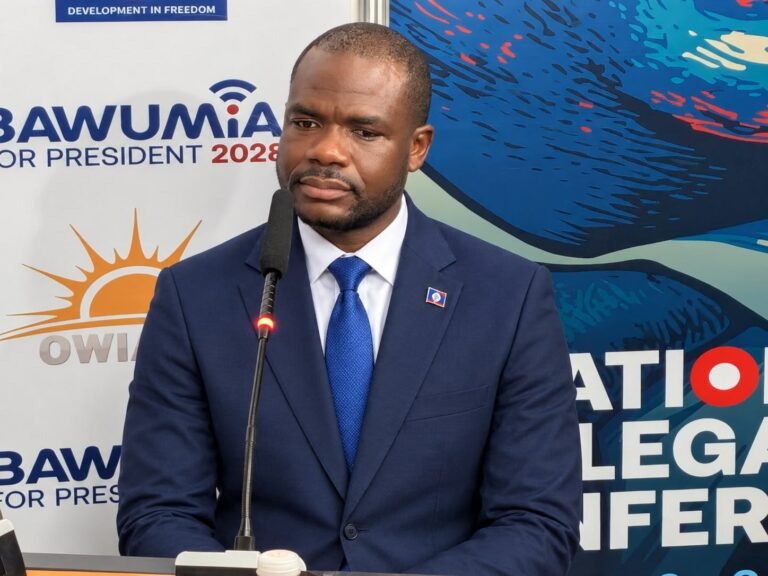
Managing Director of Ghana Water Limited (GWL), Adam Mutawakilu
The Managing Director of Ghana Water Limited (GWL), Adam Mutawakilu, has disclosed that the company spent over GHS 77 million on emergency dredging at two key water treatment facilities in the Ashanti Region to sustain water supply amid worsening siltation challenges.
Speaking at a press conference in Accra on Monday, October 20, 2025, on “The Effects of Siltation on the Operations of Ghana Water Limited, and What We Must Do Together,” Mr. Mutawakilu revealed that emergency dredging, once an exceptional measure, has now become routine as Ghana’s major rivers and reservoirs continue to choke with silt.
“Emergency dredging is no longer exceptional. At Owabi last year, dredging cost about GHS 64 million; at Mampong, about GHS 13.8 million,” he said. “These interventions kept abstraction channels open, but they required downtime that reduced supply to our communities.”
Siltation crisis
The GWL Managing Director lamented that the country’s raw-water sources are silting up at a rate far beyond what treatment plants were designed to handle. He explained that after heavy rains, turbidity at several major intake points spikes to levels that make conventional water treatment “difficult, costly, and sometimes temporarily impossible.”
According to him, unless urgent action is taken at the source, the company will “spend more each year to produce less water.” He therefore called for a national partnership under a 24-month Catchment Recovery Plan to stabilize priority rivers and reduce treatment losses.
Mr. Mutawakilu outlined that the effects of siltation go far beyond operational concerns, warning that it “breaks the system in several ways.” He explained that increased turbidity causes frequent shutdowns, damages pumps and filters, and raises energy and chemical costs.
“Water that once responded to alum now demands improved treatment after storm events dominated by fine clays and colloids,” he noted. “Abrasive solids erode pump parts and other structures, leading to multiple breakdowns, premature wear, and longer workshop queues.”
Treatment systems
The GWL boss disclosed that several treatment systems across the country — including Owabi, Barekese, Daboase, Sekyere Hemang, Nsawam, and Dalun, had been severely impacted by silt-laden rivers such as the Pra, Birim, Densu, and Volta.
He emphasised that although Ghana Water Limited has intensified preventive maintenance, filter rehabilitation, and pump refurbishment, these downstream interventions are unsustainable in the long term.
“Let me state this plainly: Ghana Water Limited is a tariff-regulated utility. We cannot immediately pass sudden cost surges to consumers, nor do we wish to; affordability matters,” he said. “But the gap between regulated revenue and siltation-driven costs stretches the company beyond reasonable limits and, if left unaddressed, threatens the sustainability of our mandate to deliver safe, reliable water,” he added.
Catchment Recovery Plan
As part of its proposed solution, Mr. Mutawakilu said the Catchment Recovery Plan will focus on riverbank stabilization, re-vegetation, targeted dredging, land-use enforcement, and community engagement.
He urged Corporate Ghana, development partners, and government agencies to co-fund the initiative, describing it as a cost-effective investment in the country’s water security.
He also commended the Government of Ghana for its renewed efforts to combat illegal mining. He also acknowledger the leadership of President John Dramani Mahama and the Ministry of Lands and Natural Resources under Hon. Emmanuel Kofi Buah for implementing initiatives such as the Blue Water Guard and the National Anti-Illegal Mining Operations Secretariat (NAIMOS).
Mr. Mutawakilu noted that while these actions have led to “significant improvements in surface turbidity” in some catchment areas, riverbeds remain heavily silted.
“Without sustained desilting operations,” he warned, “our pumps will continue to struggle to deliver quality water.”
Commitment
Reaffirming Ghana Water Limited’s commitment to transparency and efficiency, he assured stakeholders that the company would report progress on recovery projects to ensure accountability.
“With your support, GWL will recover lost capacity at priority plants, reduce treatment losses, lower energy and chemical costs, and stabilize service to households, schools, health facilities, and businesses,” he pledged.
Mr. Mutawakilu called for urgent collective action to protect the nation’s water sources.
“Water security begins at the source. If we protect the source, our plants will do the rest. Let us act with urgency and purpose—together—to keep Ghana’s taps running,” he added.
About The Author