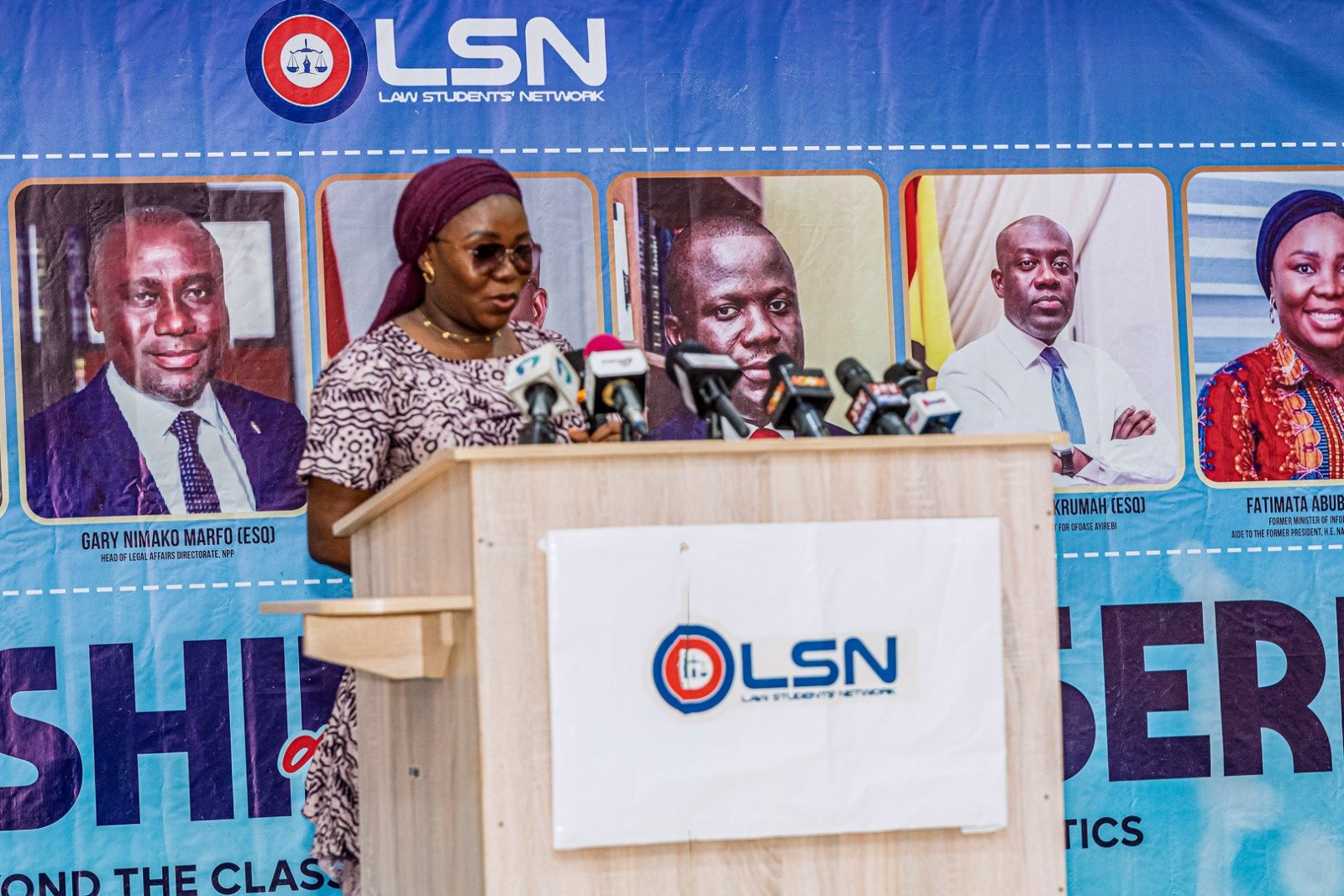
Aide to former President Nana Addo Dankwa Akufo-Addo, Fatimatu Abubakar, has called for stronger inclusion of women in political and leadership spaces, arguing that historical, social, and economic barriers continue to limit their participation despite their significant contributions to national development.
She made the call during the 2026 Law Students’ Network (LSN) Leadership and Law Series held on Saturday, April 18, 2026, at the ISSER Conference Centre, University of Ghana, Legon. The event was held under the theme, “Beyond the Classroom: Winning in Law and Politics”.
Ms. Abubakar shared personal reflections on her upbringing, career journey, and entry into public service, noting that her path into politics was not straightforward but shaped by persistence and opportunity.
She recounted that she was often described as talkative during her childhood, a trait that later contributed to her confidence in public engagement and communication. According to her, her early exposure to public life came through family connections and experiences that gradually shaped her interest in politics and governance.
“I had a brush with the NPP through my uncle who was a legendary actor… and my older sister,” she said, explaining that those early influences eventually led her into political engagement and public service years later.
Ms. Abubakar noted that two decades after those early experiences, she has now built a career within the political space, serving in various capacities linked to the New Patriotic Party (NPP) and government structures.
Reflecting on her journey, she encouraged young women who are uncertain about entering politics not to be discouraged by lack of connections or perceived barriers, stressing that determination and consistency remain key to success.
“For the ladies who are uncertain about why they should be in politics… this message is for you,” she said, adding that many women often feel excluded due to limited access to political networks or support systems.
She also emphasised the importance of male support in advancing women’s participation in leadership, arguing that gender inclusion requires collective effort rather than isolated advocacy.
“Our cumulative efforts and output is what will make this country as alive as Ghana is today. There must be strong collaboration between men and women in national development,” she urged.
Citing global studies, Ms. Abubakar referenced research by the McKinsey Global Institute suggesting that full gender equality in economic participation could significantly boost global GDP, highlighting the economic value of inclusion.
She further pointed to African development data indicating high levels of women’s participation in Ghana’s economic activities, but questioned why this level of involvement is not reflected in political representation.
“Why are we not finding them in politics? Why are we not finding them in law practice?” she asked, suggesting that structural and historical challenges continue to limit women’s access to leadership roles.
According to her, cultural and economic barriers, including financial requirements in political processes such as primaries and elections, disproportionately affect women and limit their competitiveness in political contests.
Ms. Abubakar also touched on broader issues of inheritance, access to resources, and historical gender roles, indicating that these factors have long influenced women’s ability to participate fully in public life.
She further urged reforms that promote fairness and inclusivity, stressing that national development cannot be achieved if a significant portion of the population is excluded from decision-making spaces.
About The Author